Product Overview
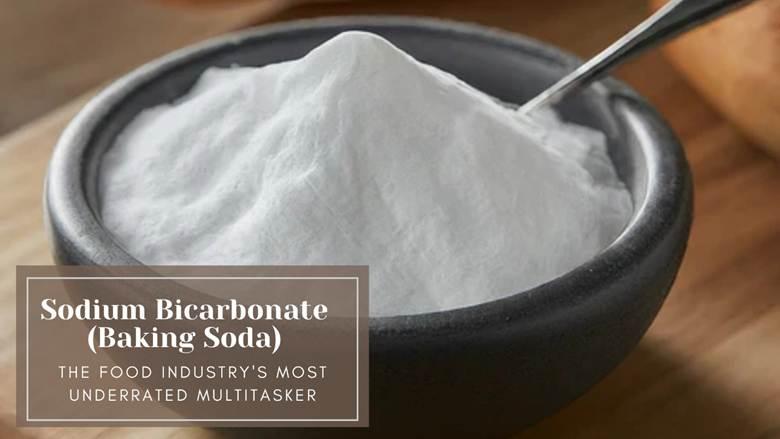
Sodium Bicarbonate, universally known as baking soda, is a white, odorless, crystalline powder with the chemical formula NaHCO3. It is produced industrially through the Solvay process or by mining and purifying natural trona ore (sodium sesquicarbonate). Its INCI name is Sodium Bicarbonate, its European food additive code is E500(ii), and its CAS number is 144-55-8. EZ Elements supplies Sodium Bicarbonate in USP and Kosher certified grade, confirming pharmaceutical-level purity and religious dietary compliance for food manufacturing.
It is easy to underestimate an ingredient this familiar. Most people picture sodium bicarbonate sitting in a box at the back of the fridge absorbing odors, or fizzing in a school science volcano. But inside a commercial food manufacturing facility, it is doing far more serious work, quietly performing six or seven distinct functions across categories as different as bread, carbonated beverages, dairy, meat processing, and canned vegetables. Few ingredients in the food technologist’s toolkit deliver this much functional range from a single, inexpensive, GRAS-classified compound, which is exactly why it deserves to be recognized as one of the most underrated multitaskers in food manufacturing.
Why It Is So Underrated
Sodium Bicarbonate rarely gets the recognition given to specialty hydrocolloids, modified starches, or designer sweeteners, mostly because it is so cheap, so old, and so familiar that it does not feel like a technical ingredient at all. Yet a closer look at its functional range tells a different story: it is simultaneously a leavening agent, a pH regulator, a meat tenderizer, a color preservative, a mild antimicrobial, and a moisture-control agent, depending on where in the formulation and process it is deployed. Few additives can claim that many distinct jobs while remaining one of the least expensive ingredients on a food manufacturer’s purchase order.
Key Features & Benefits
- Functions as a chemical leavening agent, reacting with acidic ingredients to release carbon dioxide gas that creates the light, airy texture in baked goods.
- Acts as a pH regulator and buffering agent, balancing acidity in dairy products, sauces, soups, and beverages to improve flavor, texture, and stability.
- Works as a natural meat tenderizer by raising surface pH, which denatures proteins, weakens connective tissue, and increases water retention for juicier, more tender results.
- Helps preserve the color of fruits and vegetables during processing by maintaining a slightly alkaline environment that slows pigment degradation.
- Has mild antimicrobial properties that create an alkaline environment less favorable to spoilage bacteria and fungi, supporting extended shelf life.
- Has hygroscopic, moisture-controlling properties that help manage water activity in finished food products, reducing the risk of microbial growth.
- GRAS classified by the FDA, approved as E500(ii) internationally, and Kosher certified, with one of the longest, most thoroughly documented safety records of any food ingredient.
Applications
Sodium Bicarbonate USP/Kosher is used across seven industry categories served by EZ Elements, but it is in food and beverage manufacturing that its multitasking nature truly shines.
- Chemical leavening in cakes, cookies, biscuits, muffins, and quick breads, where it reacts with an acidic ingredient such as buttermilk, yogurt, honey, or cream of tartar to produce the carbon dioxide gas bubbles that create rise and a light, fluffy texture
- pH regulation and buffering in dairy processing, including cheese and yogurt manufacturing, where it helps balance acidity for the desired flavor profile while inhibiting the growth of spoilage organisms
- Carbonated beverage production, where it is used to neutralize acids and help control the final acidity and carbonation balance of soft drinks
- Meat and poultry tenderization, used in marinades, brines, and dry rubs to raise surface pH, denature tough connective tissue proteins, and improve juiciness, a technique especially valued in Asian and Latin American cuisine for tougher cuts
- Color preservation in fruit and vegetable processing, where a controlled alkaline environment helps slow the degradation of the pigments responsible for vibrant color during cooking and canning
- Vegetable cooking and blanching, where a small addition can accelerate the breakdown of pectin in fibrous vegetables, useful in traditional recipes relying on tougher produce or cuts of meat
- Shelf-life extension in canned and processed foods, where its mild antimicrobial and moisture-buffering properties contribute to product stability over extended storage
- A foundational component of baking powder, combined with one or more leavening acids and a carrier such as cornstarch to create the most widely used chemical leavening system in commercial and home baking
- Toothpaste and mouthwash formulations, where it provides mild abrasive cleaning action and helps neutralize acids produced by oral bacteria
- Natural deodorant formulations, where its alkalinity helps neutralize odor-causing compounds on the skin
- Bath bomb and bath fizz products, where it reacts with citric acid to create the signature effervescent fizz
- Oral antacid formulations for the relief of heartburn and acid indigestion, one of its longest-established pharmaceutical applications
- Effervescent tablet formulations, reacting with an included acid to aid disintegration and dissolution
- Dry pet shampoo and grooming powder formulations, used for mild odor neutralization on pet coats between baths
- Pet litter deodorizing products, where its odor-absorbing properties help control ammonia and organic odors
- Household cleaning and deodorizing products, valued for being non-toxic, mildly abrasive, and effective at neutralizing odors on surfaces, carpets, and inside appliances
- Food-contact equipment cleaning in commercial kitchens, where its mild abrasive and degreasing properties help remove baked-on residue without harsh chemical residue
- Fire suppression in small grease and electrical fires, where its decomposition releases carbon dioxide that helps smother flames
- pH adjustment and neutralization in various industrial and laboratory processes requiring a mild, food-safe alkaline buffering agent
Technical Specifications
| Property | Specification |
| INCI Name | Sodium Bicarbonate |
| CAS No. | 144-55-8 |
| Chemical Formula | NaHCO3 |
| Food Additive Code | E500(ii) |
| Common Name | Baking Soda, Bicarbonate of Soda, Sodium Hydrogen Carbonate |
| Grade | USP and Kosher certified |
| Appearance | White, odorless, fine crystalline powder |
| Assay (Purity) | 99.0% minimum (USP/food grade) |
| pH (1% Solution) | Approximately 8.3 (mildly alkaline) |
| Solubility | Moderately soluble in water; insoluble in ethanol; solubility increases with temperature |
| Particle Size (typical baking use) | Average 70 to 90 microns for chemical leavening applications |
| Stability | Stable in dry air; decomposes with heat, releasing carbon dioxide and water |
| Storage Stability | Stable below 48% relative humidity at 40 degrees C; stable below 76% relative humidity at 25 degrees C |
| Origin | Solvay process (synthetic) or mined and refined from natural trona ore |
| Regulatory Status | GRAS (FDA); E500(ii) (EU); USP/NF grade; Kosher certified |
Why Choose EZ Elements as Your Supplier
EZ Elements supplies USP and Kosher certified Sodium Bicarbonate with verified purity, consistent particle size, and complete documentation to support food and beverage manufacturers, bakeries, dairy processors, and meat and poultry producers across Canada.
- Full documentation including Technical Data Sheet (TDS), Certificate of Analysis (COA), and Safety Data Sheet (SDS)
- USP and Kosher certification documentation for regulated food manufacturing environments
- Bulk supply with transparent, competitive pricing per kilogram across all pack sizes
- Technical support on leavening system design, pH management, meat tenderizing applications, and formulation guidance
Safety & Storage Guidelines
- Store in a cool, dry, well-ventilated area away from direct sunlight, moisture, and heat sources.
- Keep containers tightly sealed after use to prevent moisture absorption and caking of the powder.
- Avoid combining with strong acids in concentrated, poorly ventilated conditions, as rapid carbon dioxide release can occur.
- Sodium Bicarbonate readily absorbs odors from its environment; store away from strongly scented materials to protect product quality.
- Sodium Bicarbonate is generally recognized as safe; however, food manufacturers should follow recommended use levels for each application, as excessive use in baked goods can cause an alkaline “soda bite” taste and undesirable browning.
Complete handling, first aid, and disposal instructions are provided in the Safety Data Sheet (SDS) available from EZ Elements upon request.
Frequently Asked Questions
Q1: Why is Sodium Bicarbonate called the food industry’s most underrated multitasker?
Because a single, inexpensive, GRAS-classified ingredient performs at least six distinct technical functions across food manufacturing: chemical leavening in baked goods, pH regulation in dairy and beverages, meat tenderizing in marinades and brines, color preservation in fruit and vegetable processing, mild antimicrobial action supporting shelf life, and moisture control through its hygroscopic properties. Specialty ingredients costing far more per kilogram often deliver only one of these functions. Sodium Bicarbonate quietly does the work of several specialty additives at once, which is precisely why it tends to be overlooked despite being indispensable.
Q2: How does Sodium Bicarbonate work as a leavening agent?
Sodium Bicarbonate reacts with an acidic ingredient in the recipe, such as buttermilk, yogurt, honey, lemon juice, or cream of tartar, to produce carbon dioxide gas. This gas forms small bubbles within the batter or dough that act as nucleation sites; as the product bakes, those bubbles expand under heat, producing the characteristic light, airy texture associated with cakes, cookies, and quick breads. Because the reaction begins as soon as moisture and acid are present, sodium bicarbonate is typically added with the dry ingredients and the wet and dry components combined just before baking to capture as much of the leavening gas as possible.
Q3: How does Sodium Bicarbonate tenderize meat?
Sodium Bicarbonate tenderizes meat by raising the surface pH above neutral, which causes proteins, including collagen and myofibrillar proteins, to denature and unwind. This denaturation weakens the cross-links within connective tissue, converting tough collagen into a softer structure, while the altered pH also increases the meat’s ability to bind and retain water, helping it stays moist and tender during cooking. This is a well-established technique in Asian and Latin American cooking for tougher cuts of meat, typically applied as a dilute solution in a marinade or brine for a controlled period before cooking, since over-tenderizing with too high a concentration or too long an exposure can produce an undesirably mushy texture.
Q4: What is the difference between food-grade Sodium Bicarbonate and industrial-grade sodium bicarbonate?
Food-grade Sodium Bicarbonate, the form supplied for baking and food manufacturing, is produced and tested to meet edible-grade purity standards suitable for direct consumption, and is the grade used by bakers, chefs, and food technologists. Industrial-grade sodium bicarbonate, sometimes labelled sodium hydrogen carbonate in technical contexts, is intended for non-food applications including pH regulation in industrial processes, fire suppression, fungicide formulations, and cleaning products, and may not meet the same purity or testing standards required for food contact. Food manufacturers should always source USP or food-grade certified Sodium Bicarbonate, like the grade supplied by EZ Elements, for any product intended for human consumption.
Q5: Can Sodium Bicarbonate help extend the shelf life of food products?
Yes, in more than one way. Its mild alkalinity creates an environment that is less favorable to the bacteria and fungi responsible for spoilage, contributing to a modest antimicrobial effect. Its hygroscopic, moisture-absorbing properties also help manage water activity within a finished product, since excess moisture is one of the primary drivers of microbial growth and accelerated spoilage. In dairy applications specifically, its pH-buffering action helps maintain the acidity balance needed for stability and prevents undesirable curdling, which supports both flavor consistency and shelf life over time.
Q6: Where can I buy food-grade Sodium Bicarbonate (baking soda) in bulk in Canada?
Food-grade Sodium Bicarbonate USP/Kosher is available for bulk purchase directly from EZ Elements, with supply options for bakeries, dairy processors, beverage manufacturers, meat and poultry producers, and food technology teams across Canada. Contact our team for current pricing, documentation, and product samples.
Related Ingredients
The following EZ Elements ingredients are commonly used alongside Sodium Bicarbonate in food formulation, particularly in leavening and pH-management systems:
- Citric Acid (Anhydrous) USP/Kosher A common acidic reaction partner for Sodium Bicarbonate in effervescent and leavening systems, and a frequent pH-adjustment companion in beverages and condiments.
- Malic Acid Food Grade An alternative food acid that can be paired with Sodium Bicarbonate in leavening and flavor-balancing applications, offering a different, more persistent tartness profile than citric acid.
- Ascorbic Acid (Vitamin C) Food Grade An antioxidant frequently used alongside Sodium Bicarbonate in fruit and vegetable processing, where the two work together to help preserve color and freshness during preparation and storage.
Order or Enquire
Looking to buy food-grade Sodium Bicarbonate (baking soda) in bulk? Contact EZ Elements for current pricing, full product documentation, and supply options across food and beverage manufacturing. We supply bakeries, dairy processors, beverage producers, and meat and poultry manufacturers across Canada. Reach out today to request a sample, Technical Data Sheet, or a bulk pricing quote for your next project.