Product Overview
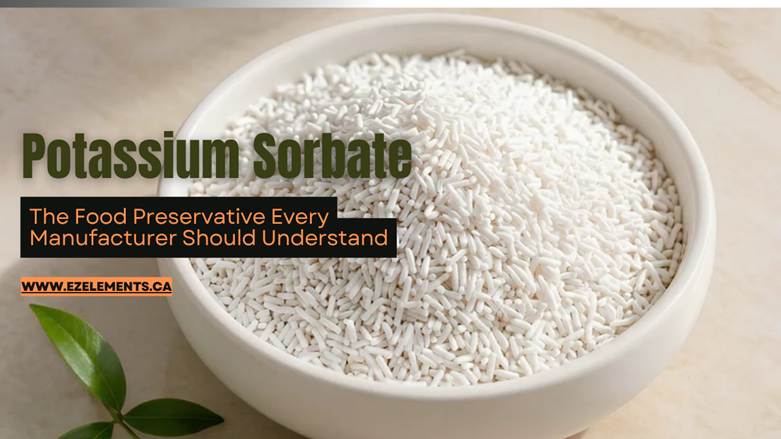
Potassium Sorbate is the potassium salt of sorbic acid, a naturally occurring unsaturated dicarboxylic acid originally discovered in the unripe berries of the rowan tree (Sorbus aucuparia) in the mid-19th century. Commercially, it is produced by neutralizing synthetically manufactured sorbic acid with potassium hydroxide, yielding a white, free-flowing, water-soluble crystalline powder that is odorless and practically tasteless at the concentrations used in food manufacturing. Its INCI name is Potassium Sorbate, its internationally recognized food additive code is E202, and its CAS number is 24634-61-5.
Potassium Sorbate is one of the most extensively reviewed, globally approved, and widely used antimicrobial food preservatives available to food manufacturers. It has been evaluated and approved by the FDA (GRAS status), the European Food Safety Authority (EFSA), the Joint FAO/WHO Expert Committee on Food Additives (JECFA), Health Canada, and the regulatory authorities of over 60 countries. Its mechanism of action is the inhibition of microbial enzyme systems, particularly those involved in the energy metabolism of mold, yeast, and certain bacteria, preventing microbial growth and reproduction in food products. It is most active in acidic to slightly acidic conditions (pH 3.0 to 6.5), where a higher proportion of sorbic acid, the biologically active undissociated form, is present in solution.
Key Features & Benefits
- Broad-spectrum antimicrobial activity against molds, yeasts, and certain bacteria, the most critical microbial threats to food product shelf life and safety.
- Effective across a wider pH range than sodium benzoate, active from pH 3.0 to 6.5, covering the majority of food and beverage product pH ranges encountered in commercial food manufacturing.
- GRAS classified by the FDA and approved as E202 internationally under Codex Alimentarius, one of the most thoroughly reviewed and approved food preservatives in regulatory history.
- Odorless and tasteless at permitted use levels, not affecting the sensory profile of food and beverage products at normal application concentrations.
- Highly water-soluble (58.2 g per 100 mL at 20 degrees C) enabling complete, easy dissolution into water-phase food systems without residue.
- Synergistic preservation with sodium benzoate, citric acid, and ascorbic acid for broader-spectrum microbial protection and reduced individual preservative concentrations.
- Available in food-grade, cosmetic-grade, and pharmaceutical-grade formats with appropriate certification documentation for each regulated application.
Applications
Potassium Sorbate serves food and beverage manufacturing as its primary application, with important additional uses across personal care, pharmaceutical, pet care, cleaning, and industrial sectors.
- Carbonated soft drinks, fruit juices, energy drinks, sports drinks, and flavored water, inhibiting yeast and mold growth throughout the product shelf life in acidic beverage environments
- Wine and cider production, preventing secondary fermentation after bottling by inhibiting residual yeast reproduction, one of its most established global food applications alongside sulfur dioxide
- Dairy products including cheese, yogurt, sour cream, cottage cheese, and cream cheese, extending refrigerated shelf life against mold and yeast spoilage at the product surface and throughout the bulk
- Bread, cakes, tortillas, muffins, and baked goods where surface mold growth during ambient shelf life represents the primary spoilage challenge
- Dried fruits, jerky, smoked fish, and dehydrated food products requiring mold and yeast control across extended ambient storage periods
- Jams, jellies, marmalades, fruit preserves, sauces, and condiments where extended shelf life after opening is a critical consumer satisfaction requirement
- Dietary supplements, nutraceutical liquid formulations, and functional food products requiring preservative protection of the aqueous phase
- Combination preservation systems with sodium benzoate and citric acid in acidic beverages and condiments for enhanced broad-spectrum microbial protection
- Shampoos, conditioners, and liquid hair care products as a water-phase preservative providing effective antimicrobial protection at low concentrations in rinse-off formulations
- Facial moisturizers, serums, toners, and eye creams where mild preservation is essential at concentrations safe for leave-on skin contact across diverse skin types
- Baby wipes, facial wipes, and cleansing wipes requiring effective but gentle preservation in high-moisture wet substrate personal care products
- Sunscreen formulations, body lotions, and water-based cosmetics requiring broad-spectrum preservative protection through the full product shelf life
- Natural and clean-label personal care formulations where its mild, widely approved profile is preferred alongside sodium benzoate for comprehensive preservation
- Oral liquid pharmaceutical formulations including syrups, suspensions, tonics, and elixirs as a recognized mild antimicrobial preservative in multi-dose liquid medicines
- Topical pharmaceutical creams, gels, and ointments requiring antimicrobial preservation throughout the shelf life of multi-dose containers
- Vitamin and mineral supplements, herbal remedies, and nutraceutical liquid formulations where water activity requires preservative protection
- Medicated shampoos and dermatological preparations where mild, effective antimicrobial preservation at skin-safe concentrations is required
- Moist pet food, commercial animal feed, and companion animal dietary supplements where Potassium Sorbate is a permitted and widely used feed preservative against mold and yeast
- Liquid pet grooming products including shampoos, coat sprays, and conditioning rinses requiring microbial preservation in water-based formats
- Pet dietary supplement liquids and health product formulations for dogs, cats, and companion animals
- Household and institutional liquid cleaning products as a preservative additive preventing microbial spoilage of the bulk product during storage and use
- Liquid hand soaps, dish soaps, and laundry products requiring microbial stability through the full product shelf life in high-water-activity systems
- Wet wipes and pre-moistened cleaning products where water-based substrate requires antimicrobial preservation against bacteria, yeast, and mold
- Coatings, paints, adhesives, and sealants as a fungistatic additive preventing microbial deterioration during bulk storage and through the product application lifetime
- Lubricants, cutting fluids, and metalworking emulsions where microbial contamination reduces product performance, creates odour, and causes equipment fouling
- Textile processing applications where mold and mildew prevention during fiber storage and transport is required for product quality maintenance
Technical Specifications
| Property | Specification |
| INCI Name | Potassium Sorbate |
| CAS No. | 24634-61-5 |
| Chemical Formula | C6H7KO2 |
| Food Additive Code | E202 |
| Common Name | Potassium Sorbate, Sorbistat-K, E202 |
| Appearance | White crystalline granules or powder; odorless and practically tasteless |
| Assay (Purity) | 99.0% minimum (food and pharmaceutical grade) |
| pH (1% Solution) | 7.0 to 8.0 |
| Effective pH Range | Active from pH 3.0 to 6.5, broader than Sodium Benzoate (effective to pH 4.5 only) |
| Solubility | Freely soluble in water (58.2 g per 100 mL at 20 degrees C); slightly soluble in alcohol |
| Molecular Weight | 150.22 g/mol |
| Melting Point | 270 degrees C (decomposes) |
| Origin | Potassium salt of sorbic acid produced by neutralization with potassium hydroxide |
| Recommended Use Level | 0.05% to 0.1% in food (market-specific regulatory limits apply); 0.1% to 0.3% in cosmetics |
| Regulatory Status | GRAS (FDA); E202 (EU Codex); USP, EP, and FCC compliant; approved in 60+ countries |
Why Choose EZ Elements as Your Supplier
EZ Elements supplies food-grade, cosmetic-grade, and pharmaceutical-grade Potassium Sorbate with verified purity, consistent quality, and complete documentation to support manufacturing across food and beverage, personal care, pharmaceutical, pet care, and industrial applications in Canada and North America.
- Full documentation including Technical Data Sheet (TDS), Certificate of Analysis (COA), and Safety Data Sheet (SDS)
- Multiple grade options with appropriate compliance documentation for food, cosmetic, and pharmaceutical applications
- Bulk supply with competitive, transparent pricing per kilogram across all pack sizes
- Technical support on effective use levels, pH optimization, synergistic preservation combinations, and regulatory compliance across all industries
Safety & Storage Guidelines
- Store in a cool, dry, well-ventilated area away from direct sunlight, heat, and moisture; Potassium Sorbate is hygroscopic and absorbs moisture if containers are left unsealed.
- Keep containers tightly sealed immediately after use to prevent moisture absorption and caking of the crystalline powder.
- Use within regulatory-specified concentration limits for each application type; maximum permitted levels differ between food, pharmaceutical, and cosmetic applications and vary by jurisdiction.
- Wear protective gloves and avoid fine powder dust inhalation during bulk handling in production environments.
- Shelf life is typically 2 years from manufacture date when stored correctly in sealed, cool, and dry conditions.
Complete handling, first aid, and disposal instructions are provided in the Safety Data Sheet (SDS) available from EZ Elements upon request.
Frequently Asked Questions
Q1: Why does every food manufacturer need to understand Potassium Sorbate?
Potassium Sorbate is genuinely one of the foundational food preservatives in commercial food manufacturing because it addresses the most commercially significant spoilage challenge in the broadest range of food categories, mold and yeast growth. These microorganisms are responsible for the majority of food product returns, shelf-life failures, and consumer complaints across bakery, dairy, beverage, condiment, and preserved food categories. Understanding how Potassium Sorbate works, when it is effective, how to optimize its performance through pH management and synergistic combinations, and what its regulatory limits are across different food categories is essential knowledge for any food product developer or quality assurance professional.
Q2: What is the difference between Potassium Sorbate and Sodium Benzoate?
Both are widely used mild food preservatives but with complementary activity profiles that make them work better together than either alone. Potassium Sorbate (E202) is most effective against molds and yeasts across a broader pH range of 3.0 to 6.5, making it suitable for a wider variety of food formulations including dairy products, baked goods, and beverages with pH values above 4.5. Sodium Benzoate (E211) is most effective at pH below 4.5 where a higher proportion of undissociated benzoic acid is present, giving it stronger antibacterial activity in highly acidic foods like carbonated beverages and acidified condiments. Combining both at appropriate concentrations provides synergistic preservation across a broader pH range and microbial spectrum than either ingredient provides alone, which is why the combination is one of the most widely used preservation systems in commercial food manufacturing globally.
Q3: How should Potassium Sorbate be incorporated into food formulations?
Potassium Sorbate dissolves readily in water at room temperature. For most food applications, it is dissolved in a portion of the water phase of the formulation before other ingredients are added. Effective use requires attention to the formulation pH, as pH increases above 6.5, a progressively smaller proportion of sorbate is present in the undissociated sorbic acid form, reducing antimicrobial efficacy. For optimal performance, the formulation pH should be adjusted to 6.5 or below using citric acid or another food-approved acidulant before or alongside Potassium Sorbate incorporation. The dissolved Potassium Sorbate solution should be added uniformly to ensure consistent preservative distribution throughout the food product.
Q4: Can Potassium Sorbate be used in wine and fermented beverages?
Yes. Potassium Sorbate is a standard approved preservative in commercial winemaking and cider production where it is added at bottling to prevent secondary fermentation caused by residual yeast in wines with residual sugar. It does not kill existing yeast but prevents their reproduction, stopping CO2 production and pressure buildup in sealed bottles. In wine, it is typically used at concentrations of 150 to 300 mg per liter in combination with sulfur dioxide (SO2) for comprehensive microbial stability. It is important to note that Potassium Sorbate alone without SO2 may not provide complete protection in wine, as it does not prevent lactic acid bacteria from producing a geranium-like off-flavor from the sorbate itself, so SO2 is required to control this bacterial reaction.
Q5: What concentration of Potassium Sorbate is permitted in food products in Canada?
In Canada, the maximum permitted levels for Potassium Sorbate (expressed as sorbic acid) in food products are regulated by Health Canada under the Food and Drug Regulations. Permitted levels vary by food category, for example margarine is permitted up to 0.2 g per 100 g, pickles and relishes up to 0.1 g per 100 g, and beverages at levels consistent with good manufacturing practice within defined limits. Food manufacturers should verify the specific permitted level for their target food category under the applicable Canadian food regulations and ensure that label declarations and use levels comply with current Health Canada requirements. The FCC (Food Chemicals Codex) and international Codex standards can also be referenced for comparative guidance.
Q6: Where can I buy Potassium Sorbate in bulk in Canada?
Potassium Sorbate is available for bulk purchase from EZ Elements in food-grade, cosmetic-grade, and pharmaceutical-grade formats, with supply options for food manufacturers, beverage producers, personal care brands, pharmaceutical formulators, pet food producers, and industrial users across Canada and North America. Contact our team for current pricing, documentation, and product samples.
Related Ingredients
The following EZ Elements ingredients are commonly used alongside Potassium Sorbate in food, personal care, and preservation formulations:
- Sodium Benzoate Synergistic broad-spectrum preservative with stronger antibacterial activity in acidic conditions; the most widely used combination partner for Potassium Sorbate in food, personal care, and pharmaceutical preservation systems.
- Citric Acid (Anhydrous) USP/Kosher pH-lowering acidulant that enhances Potassium Sorbate efficacy by reducing formulation pH to the optimal range for sorbate antimicrobial activity; an essential formulation partner in beverages, sauces, and condiments.
- Aloe Vera Juice Natural botanical ingredient frequently preserved with Potassium Sorbate; the two are commonly combined in personal care, pet care, and natural product formulations requiring both botanical actives and effective microbial protection.
Order or Enquire
Looking to buy Potassium Sorbate in bulk? Contact EZ Elements for current pricing, full product documentation, and supply options across food and beverage, personal care, pharmaceutical, pet care, cleaning, and industrial applications. We supply brands, manufacturers, and formulators across Canada and North America. Reach out today to request a sample, Technical Data Sheet, or a bulk pricing quote.