Product Overview
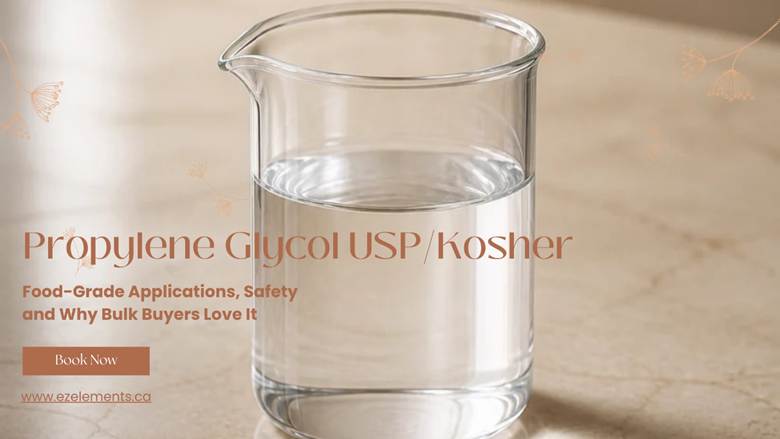
Propylene Glycol, chemically known as 1,2-propanediol, is a clear, colorless, odorless, slightly viscous liquid with the chemical formula C3H8O2. It is a synthetic diol typically produced from propylene oxide through hydrolysis, though plant-based, bio-derived versions are also commercially available. Its INCI name is Propylene Glycol, its internationally recognized food additive code is E1520, and its CAS number is 57-55-6. EZ Elements supplies Propylene Glycol in USP (United States Pharmacopeia) and Kosher certified grade, the highest purity specification available, meeting the strict requirements of the USP monograph, the Food Chemicals Codex (FCC), the European Pharmacopoeia (EP), and Kosher dietary law certification.
Propylene Glycol is one of the most chemically versatile and broadly approved ingredients available across the food, pharmaceutical, personal care, and industrial sectors. It is GRAS classified by the FDA under 21 CFR 184.1666 for direct food use, listed in the FDA Inactive Ingredient Database for pharmaceutical formulation, and accepted across cosmetic regulatory frameworks worldwide. Its defining functional properties, including its ability to attract and retain moisture, its excellent solvency for both polar and non-polar compounds, its low freezing point, and its low toxicity profile relative to other glycols such as ethylene glycol, explain why it appears in such a wide range of manufactured products and why bulk buyers across multiple industries consistently choose it as a dependable, multi-purpose ingredient.
Why Bulk Buyers Love It
Propylene Glycol has earned a reputation among procurement teams and formulators as one of the most cost-effective, dependable bulk ingredients available, for several practical reasons that matter directly to purchasing decisions:
- Single ingredient, multiple functions: the same USP-grade material works as a humectant in food, a solvent in pharmaceuticals, a moisturizing agent in personal care, and a heat-transfer fluid in industrial brewing and dairy operations, reducing the number of distinct raw materials a multi-category manufacturer needs to stock and manage.
- Long, stable shelf life: Propylene Glycol does not degrade, oxidize, or develop rancidity the way many oils and natural ingredients do, meaning bulk inventory can be held for extended periods without quality loss or waste.
- Consistent, predictable performance: as a synthetic, tightly specified molecule rather than a natural extract, USP-grade Propylene Glycol has minimal batch-to-batch variability, which simplifies formulation, quality control, and regulatory documentation for high-volume manufacturers.
- Strong price stability per unit of function: because it is produced at industrial scale globally, Propylene Glycol typically offers a lower cost per kilogram than comparable specialty humectants or solvents, particularly attractive when purchased in bulk drums or totes.
- One certification, broad regulatory coverage: a single USP and Kosher certified grade satisfies food, pharmaceutical, and personal care regulatory requirements simultaneously, reducing the documentation burden for manufacturers serving multiple market segments.
Key Features & Benefits
- USP and Kosher certified, meeting the highest purity standards for pharmaceutical, food-grade, and religious dietary compliance manufacturing requirements.
- GRAS classified by the FDA under 21 CFR 184.1666 for direct food use and approved internationally as food additive E1520.
- Outstanding humectant properties, attracting and retaining moisture in food, personal care, and pharmaceutical formulations to maintain product texture and extend shelf life.
- Excellent solvency for both polar and non-polar compounds, making it one of the most versatile carriers for flavors, fragrances, colorants, and active pharmaceutical ingredients.
- Significantly lower toxicity than ethylene glycol, which is the basis for its widespread acceptance in food, pharmaceutical, and personal care applications where ethylene glycol would never be permitted.
- Low freezing point and effective freeze-point depression properties, valuable in cold-chain food processing, brewing, and dairy heat-transfer fluid applications.
- Stable across a wide pH and temperature range, compatible with the majority of food, pharmaceutical, and cosmetic ingredient systems without reactivity concerns.
Applications
Propylene Glycol USP/Kosher is used across seven industry categories served by EZ Elements, reflecting its position as one of the most broadly applicable bulk ingredients in modern manufacturing.
- Humectant in baked goods, including bread, cakes, and pastries, maintaining moisture content and extending freshness throughout shelf life
- Solvent and carrier for food flavoring compounds and food colorants, particularly in beverages, baked goods, and confectionery where uniform distribution of concentrated flavors and colors is required
- Stabilizer in syrups, dressings, and liquid food formulations, preventing crystallization and maintaining consistent texture across storage and temperature fluctuations
- Low-temperature heat-transfer fluid in brewing, dairy processing, and ice cream manufacturing, where its food-safe profile allows direct use in equipment with potential incidental food contact
- Anti-caking and moisture-retention agent in pet treats, marshmallows, and other soft confectionery requiring extended textural softness
- Carrier for vitamins and functional additives in fortified food and beverage products requiring uniform nutrient distribution
- Moisturizers, lotions, creams, serums, and gels as a primary humectant, drawing and retaining moisture in the skin and improving overall product hydration performance
- Shampoos, conditioners, and hair care products as a humectant and solvent improving ingredient compatibility and product texture
- Deodorants and antiperspirants where its works as a solvent and skin-conditioning agent
- Fragrance and essential oil coupling agent, helping blend aromatic compounds smoothly and consistently into finished personal care formulations
- Color cosmetics, including foundations and lip products, where it improves spread ability and prevents premature drying of the formulation
- Solvent and carrier for active pharmaceutical ingredients in oral, topical, and injectable medications, listed in the FDA Inactive Ingredient Database for multiple dosage forms
- Vehicle in topical creams, ointments, and gels, improving the spreadability and skin penetration of medicated formulations
- Stabilizer and solubilizer in liquid oral medications, including syrups and elixirs, where it helps dissolve and stabilize active ingredients that are otherwise poorly water-soluble
- Preservative-enhancing agent in multi-dose pharmaceutical formulations, working alongside other preservatives to extend antimicrobial protection through reduced water activity
- Moisture-retention agent and texture enhancer in semi-moist pet food and pet treats, helping maintain a soft, palatable texture throughout shelf life
- Carrier for flavoring and palatability-enhancing additives in commercial pet food and treat manufacturing
- Solvent and humectant in topical veterinary and pet grooming preparations requiring smooth, stable formulation texture
- Low-temperature heat-transfer fluid in food and beverage processing facilities, breweries, and dairy plants, where its low toxicity allows safe use in equipment with potential food contact
- Antifreeze and de-icing fluid formulations, valued as a lower-toxicity alternative to ethylene glycol in applications such as aircraft de-icing and food-facility freeze protection
- Hydraulic and brake fluid component in specialty automotive and industrial fluid formulations
- Lubricant for machinery and mechanical systems in manufacturing environments requiring a food-safe or low-toxicity lubricating fluid
- Solvent and humectant additive in liquid cleaning product formulations, improving solubilization of active cleaning ingredients and product consistency
- Antimicrobial preservation support in cleaning and sanitizing formulations, where reduced water activity contributes to overall product microbial stability
Technical Specifications
| Property | Specification |
| INCI Name | Propylene Glycol |
| CAS No. | 57-55-6 |
| Chemical Formula | C3H8O2 |
| Chemical Name | 1,2-Propanediol |
| Food Additive Code | E1520 |
| Grade | USP (United States Pharmacopeia) and Kosher certified |
| Appearance | Clear, colorless, slightly viscous liquid |
| Odor | Practically odorless |
| Taste | Slightly sweet |
| Assay (Purity) | 99.5% minimum (USP specification) |
| Water Content | Maximum 0.5% |
| Specific Gravity | 1.035 to 1.037 (at 25 degrees C) |
| Boiling Point | Approximately 188 degrees C |
| Freezing Point | Approximately minus 59 degrees C |
| Solubility | Completely miscible with water, acetone, and chloroform |
| Origin | Synthesized from propylene oxide via hydrolysis; plant-based bio-derived grades also available |
| Recommended Use Level | Variable by application; 1% to 30% in personal care; per FDA limits in food applications |
| Regulatory Status | GRAS (FDA, 21 CFR 184.1666); E1520 (EU); USP, EP, FCC compliant; FDA Inactive Ingredient Database listed |
Why Choose EZ Elements as Your Supplier
EZ Elements supplies USP and Kosher certified Propylene Glycol with consistent purity, verified regulatory compliance documentation, and complete technical support for food manufacturers, personal care brands, pharmaceutical formulators, and industrial users across Canada and North America. Our bulk supply model is built specifically for the procurement realities described above, helping multi-category manufacturers simplify sourcing with a single certified grade.
We supply food and beverage manufacturers, personal care formulators, pharmaceutical companies, pet food producers, and industrial users, providing:
- Full documentation including Technical Data Sheet (TDS), Certificate of Analysis (COA), and Safety Data Sheet (SDS)
- USP and Kosher certification confirming pharmaceutical-grade purity and religious dietary compliance
- Bulk supply with transparent, competitive pricing per kilogram and per liter, scaled for drum and tote-level purchasing
- Technical support on formulation uses levels, regulatory compliance, and application-specific guidance across all industries
Safety & Storage Guidelines
- Store in a cool, dry, well-ventilated location in tightly sealed containers away from direct sunlight and heat sources.
- Keep containers sealed between uses; Propylene Glycol is hygroscopic and will absorb atmospheric moisture if left exposed, which can dilute concentration over time.
- Propylene Glycol has a significantly lower toxicity profile than ethylene glycol, which is the basis for its approval in food, pharmaceutical, and personal care applications; however, always use within the regulatory-permitted concentration for the intended application.
- Avoid prolonged or repeated skin contact with undiluted material in industrial handling contexts; standard protective gloves and eyewear are recommended during bulk transfer.
- Shelf life is typically 2 years or longer from manufacture date when stored correctly in sealed containers under cool, dry conditions; Propylene Glycol does not degrade or oxidize the way natural oils do.
Complete handling, first aid, and disposal instructions are provided in the Safety Data Sheet (SDS) available from EZ Elements upon request.
Frequently Asked Questions
Q1: Which industries use Propylene Glycol USP/Kosher?
Propylene Glycol USP/Kosher is used across seven industries: Food and Beverages (humectant, flavor and color solvent, syrup stabilizer, and heat-transfer fluid in brewing and dairy), Personal Care (moisturizers, shampoos, deodorants, and fragrance coupling agent), Pharmaceutical (solvent and carrier for active pharmaceutical ingredients in oral, topical, and injectable formulations), Pet Care (moisture retention in semi-moist pet food and treats), Industrial (heat-transfer fluid, antifreeze, hydraulic fluid, and machinery lubricant), Cleaning and Sanitation (solvent and humectant additive in liquid cleaning formulations), and Components (vaping e-liquid base, fog machine fluid, and DIY cosmetic formulation).
Q2: Is Propylene Glycol safe for use in food and personal care products?
Yes. Propylene Glycol is GRAS classified by the FDA for direct food use under 21 CFR 184.1666 and is listed in the FDA Inactive Ingredient Database for pharmaceutical use. It has been extensively studied and has a significantly lower toxicity profile than ethylene glycol, the related but far more toxic compound it is sometimes confused with due to similar naming. This difference is the entire basis for Propylene Glycol’s widespread regulatory approval across food, pharmaceutical, and personal care applications, where ethylene glycol would never be permitted. Always use Propylene Glycol within the concentration limits established for the specific application and target regulatory market.
Q3: What is the difference between food-grade and USP-grade Propylene Glycol?
Food-grade Propylene Glycol is manufactured to meet FDA standards for food use and complies with the Food Chemicals Codex (FCC). USP-grade Propylene Glycol meets the more rigorous purity specifications established by the United States Pharmacopeia, including tighter controls on water content, identification testing, and impurity limits, making it suitable for pharmaceutical applications in addition to food use. In practice, USP-grade material exceeds food-grade requirements and can be used interchangeably for food applications, which is why EZ Elements supplies the higher USP and Kosher certified specification as a single grade suitable across food, pharmaceutical, and personal care manufacturing.
Q4: Why is Propylene Glycol commonly confused with ethylene glycol, and are they the same?
No, they are chemically distinct compounds despite the similar name. Ethylene glycol (C2H6O2) is significantly more toxic to humans and animals, even in small quantities, and is restricted to industrial applications such as automotive antifreeze, where it is typically combined with bittering agents to discourage accidental ingestion. Propylene Glycol (C3H8O2) has one additional carbon atom in its structure, which fundamentally changes its metabolic pathway in the body and results in a much lower toxicity profile. This difference is precisely why Propylene Glycol, and not ethylene glycol, is the glycol approved for use in food, pharmaceutical, and personal care products.
Q5: What makes Propylene Glycol a good choice for bulk purchasing compared to specialty humectants?
For manufacturers purchasing raw materials at scale, Propylene Glycol offers several practical procurement advantages. It is produced at significant industrial scale globally, which generally makes it more price-stable and cost-effective per kilogram than many specialty natural humectants. It does not degrade, oxidize, or develop rancidity over time, allowing extended bulk storage without quality concerns or waste. It’s consistent, tightly specified chemical identity as a synthetic molecule means minimal batch-to-batch variability, simplifying formulation and quality control documentation. And because a single USP and Kosher certified grade satisfies food, pharmaceutical, and personal care regulatory frameworks simultaneously, multi-category manufacturers can often consolidate their humectant and solvent sourcing into one certified bulk ingredient rather than managing multiple specialty materials.
Q6: Where can I buy Propylene Glycol USP/Kosher in bulk in Canada?
Propylene Glycol USP/Kosher is available for bulk purchase directly from EZ Elements, with supply options for food manufacturers, personal care brands, pharmaceutical formulators, pet food producers, and industrial users across Canada and North America. Contact our team for current pricing, documentation, and product samples.
Related Ingredients
The following EZ Elements ingredients are commonly used alongside Propylene Glycol in food, personal care, and pharmaceutical formulations:
- Glycerin USP/Kosher The complementary polyol humectant; frequently combined with Propylene Glycol in vaping e-liquids, personal care formulations, and pharmaceutical preparations where different viscosity needed in the same product.
- Citric Acid (Anhydrous) USP/Kosher pH adjuster and acidulant used alongside Propylene Glycol in food and beverage formulations requiring both moisture retention and acidity control for flavor and preservation.
- Potassium Sorbate Antimicrobial preservative often used alongside Propylene Glycol in personal care and food formulations, where Propylene Glycol’s humectant properties reduce water activity while Potassium Sorbate provides additional preservative protection.
Order or Enquire
Looking to buy Propylene Glycol USP/Kosher in bulk? Contact EZ Elements for current pricing, full product documentation, and supply options across food and beverage, personal care, pharmaceutical, pet care, industrial, and cleaning applications. We supply brands, manufacturers, and formulators across Canada and North America. Reach out today to request a sample, Technical Data Sheet, or a bulk pricing quote for your next project.