Product Overview
Xanthan Gum is a naturally derived, high-molecular-weight polysaccharide produced through the fermentation of glucose or sucrose by the bacterium Xanthomonas campestris. First developed through USDA-sponsored research in the 1960s and commercially approved shortly after, it has since become the most widely used microbial polysaccharide in the world, with applications spanning food and beverages, personal care, pharmaceuticals, pet care, and industrial processes. Its INCI name is Xanthan Gum, its food additive code is E415, and its CAS number is 11138-66-2.
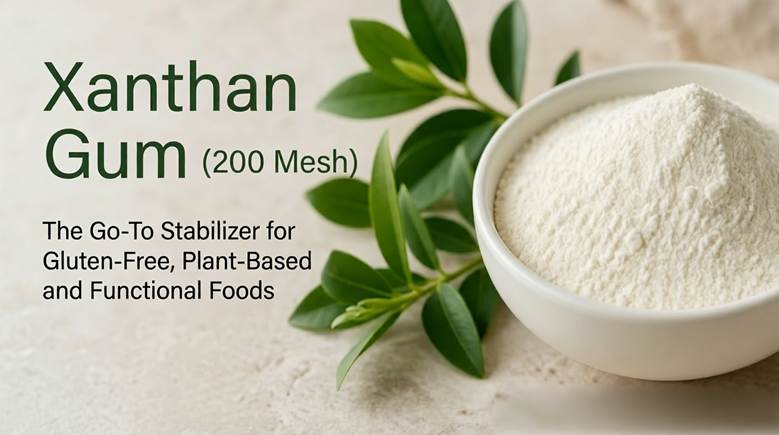
EZ Elements supplies Xanthan Gum in the 200-mesh particle size specification, a finely milled grade specifically chosen for its rapid hydration, smooth dispersion, and compatibility with instant beverage mixes, gluten-free doughs, emulsion-based personal care products, and precision pharmaceutical formulations that benefit from a smaller, faster-hydrating particle. At this mesh size, at least 90% of particles pass through a 200-mesh sieve, producing a cream-white, free-flowing powder that disperses quickly into both cold and hot aqueous systems without the lumping and clumping that can occur with coarser mesh grades.
What places Xanthan Gum in the go-to position for gluten-free, plant-based, and functional food manufacturing is a combination of functional properties that few other hydrocolloids can match across as broad a range of conditions: it thickens and stabilizes in cold water, survives heat processing and acidic pH, provides shear-thinning flow behavior that makes products pourable but cling-stable, and does so at concentrations as low as 0.05% to 0.5%, giving formulators significant stabilization power with minimal ingredient cost and label impact.
Why It Is the Go-To Stabilizer for Three Growing Categories
Gluten-free, plant-based, and functional foods are among the fastest-growing categories in food manufacturing today, and Xanthan Gum has become foundational to all three for specific, technically grounded reasons.
- In gluten-free baking, Xanthan Gum replaces the viscoelastic network that gluten would otherwise provide. Gluten forms an elastic, extensible protein network in dough that traps gas bubbles during leavening, gives bread its chew and structure, and prevents baked goods from crumbling. Without it, gluten-free doughs and batters behave more like loose slurries than cohesive doughs. Xanthan Gum, at concentrations typically between 0.2% and 0.5% of flour weight, rebuilds some of this network function, binding particles together, improving dough extensibility, helping trap CO2 during proofing and baking, and significantly reducing the crumbling tendency of gluten-free finished products.
- In plant-based foods, including oat milk, almond milk, plant-based meat, and dairy-free yogurt, Xanthan Gum stabilizes emulsions and suspensions that would otherwise separate, settle, or develop a gritty or watery texture. Plant proteins and fats behave very differently from their dairy counterparts, and the absence of casein micelles and natural dairy fat globule membranes means that stabilizers like Xanthan Gum become essential for producing the smooth, consistent, shelf-stable product texture consumers expect.
- In functional foods, including protein-fortified beverages, fiber-enriched drinks, and nutraceutical-loaded products, Xanthan Gum helps keep active ingredients evenly suspended throughout the product rather than settling at the bottom of the bottle or bag. Its pseudoplastic, shear-thinning behavior means the product flows easily when shaken or poured but quickly regains viscosity at rest, maintaining that even suspension until the moment of consumption.
Key Features & Benefits
- Produced by natural fermentation of glucose or sucrose using Xanthomonas campestris bacteria, a renewable, non-GMO, vegan, and gluten-free production process.
- 200 mesh particle size providing faster hydration, smoother dispersion, and lower clumping risk compared to coarser 80 mesh grades, particularly in cold-process and instant-mix applications.
- Pseudoplastic or shear-thinning behavior, thickening at rest to stabilize suspensions and emulsions but thinning under applied shear during pumping, spraying, or pouring, then recovering viscosity immediately after.
- Effective at very low concentrations, typically 0.05% to 0.5% in finished formulations, delivering significant stabilization with minimal label and cost impact.
- Stable across an extremely wide temperature range, from frozen to over 100 degrees C, and across the full food-relevant pH range from strongly acidic to alkaline.
- Synergistic with other hydrocolloids including Guar Gum, Locust Bean Gum, and Konjac Glucomannan, with combinations producing significantly higher viscosity than either ingredient alone.
- GRAS classified by the FDA, approved as E415 internationally, Kosher and Halal certified, non-GMO, and vegan, supporting broad clean-label, allergen-free, and dietary-compliant product positioning.
Applications
Xanthan Gum 200 Mesh is used across six industry categories served by EZ Elements, anchored by food and beverage manufacturing as its largest and most established application.
- Gluten-free bread, cakes, cookies, and baked goods, where it replaces the structural and binding function of gluten, improving dough extensibility, gas retention during baking, and reducing crumbling in the finished product
- Plant-based milk alternatives including oat milk, almond milk, rice milk, and soy milk, where it prevents fat and particle settling and provides the smooth, creamy mouthfeel consumers expect
- Plant-based meat products, dairy-free yogurt, and vegan cheese alternatives, where it contributes to the texture, binding, and stability that plant proteins alone cannot fully provide
- Salad dressings, sauces, gravies, and condiments, where its shear-thinning flow behavior allows easy pouring while providing cling-stable coating performance on food surfaces
- Functional beverages, protein drinks, fiber-enriched beverages, and meal replacement shakes, where it suspends insoluble actives, proteins, and fibers evenly throughout the product
- Instant beverage and powder mix formulations, where its 200-mesh particle size ensures rapid, lump-free hydration even in cold water during preparation
- Ice cream, frozen desserts, and dairy products, where it controls ice crystal formation during freezing and storage, contributing to smoother texture and improved melt resistance
- Fruit juices, nectars, and fruit beverages, where it prevents pulp settling and maintains an appealing, evenly distributed product throughout shelf life
- Facial creams, body lotions, and moisturizing gels as a natural thickener and stabilizer providing smooth, even texture and preventing ingredient separation
- Toothpaste and oral care gels, where it provides the gel-like consistency, non-drip application, and stability on the brush that these products require
- Shampoos, conditioners, and liquid personal care products as a natural, COSMOS-accepted rheology modifier and thickener replacing synthetic polymers
- Natural and organic certified personal care formulations where it is widely accepted as a naturally derived, biodegradable stabilizer
- Tablet and capsule binders and controlled-release matrix systems, where its gel-forming ability with water helps modulate the rate of active ingredient dissolution and release
- Oral liquid suspension stabilizers, preventing sedimentation of insoluble active pharmaceutical ingredients in multi-dose liquid medicines
- Ophthalmic viscosity-enhancing formulations, where it improves corneal contact time and comfort in eye drop preparations
- Canned pet food and wet pet food formulations, where it stabilizes the gravy and jelly formats that pet owners and their animals expect from premium wet pet food products
- Pet treat and dental chew binding, contributing to cohesion and controlled texture in soft and semi-moist formats
- Pet supplement liquid formulations requiring suspension of active ingredients throughout shelf life
- Liquid cleaning products, dish soaps, and surface cleaners, where it contributes viscosity, cling-to-surface stability, and natural thickening without synthetic polymer additives
- Eco-certified cleaning formulations where its biodegradable, naturally derived profile supports green cleaning product positioning
- Oilfield and petroleum drilling fluid formulations, one of its largest volume industrial applications globally, where it provides viscosity, suspension, and fluid loss control under high-temperature, high-salinity conditions
- Coatings, adhesives, and printing ink formulations, where its rheology-modifying properties improve application behavior and product stability
- Agricultural spray formulations and pesticide suspensions, where it improves spray adhesion to leaf surfaces and prevents settling of insoluble active compounds
Technical Specifications
| Property | Specification |
| INCI Name | Xanthan Gum |
| CAS No. | 11138-66-2 |
| Food Additive Code | E415 |
| Common Name | Xanthan Gum, Xanthan |
| Particle Size | 200 Mesh (minimum 90% pass through 200-mesh sieve; 100% pass through 80-mesh) |
| Appearance | Cream-white to off-white free-flowing powder |
| Odor | Practically odorless |
| Viscosity (1% solution, 25 degrees C) | 1,200 to 1,600 mPa·s (typical food-grade specification) |
| pH Stability | Stable from pH 3.0 to 12.0 |
| Temperature Stability | Stable from frozen conditions through over 100 degrees C |
| Solubility | Soluble in both cold and hot water; not soluble in organic solvents |
| Rheology | Pseudoplastic (shear-thinning); recovers viscosity immediately after shear is removed |
| Moisture Content | Maximum 15% (FCC specification) |
| Origin | Fermentation of corn starch or other carbohydrates by Xanthomonas campestris bacteria |
| Regulatory Status | GRAS (FDA); E415 (EU); FCC compliant; Kosher; Halal; non-GMO; vegan |
Why Choose EZ Elements as Your Supplier
EZ Elements supplies food-grade Xanthan Gum 200 Mesh with consistent viscosity specification, verified particle size, and complete documentation to support food manufacturers, personal care brands, pharmaceutical formulators, and pet food producers across Canada.
- Full documentation including Technical Data Sheet (TDS), Certificate of Analysis (COA), and Safety Data Sheet (SDS)
- 200 mesh particle size with consistent viscosity specification for reliable performance across food, personal care, and pharmaceutical applications
- Bulk supply with transparent, competitive pricing per kilogram across all available pack sizes
- Technical support on hydration methods, synergistic hydrocolloid combinations, gluten-free formulation guidance, and plant-based food stabilization
Safety & Storage Guidelines
- Store in a cool, dry, well-ventilated area away from direct sunlight, heat, and moisture to prevent premature hydration and caking of the powder.
- Keep bags or containers tightly sealed after each use; even partial hydration from humid air can reduce powder flowability and cause clumping.
- When dispersing into water, pre-blend Xanthan Gum with other dry ingredients or disperse in a small amount of oil before adding to the water phase to prevent lumping during hydration.
- Handle powder with appropriate respiratory protection in bulk production environments, as fine powder inhalation is a standard occupational consideration with any fine powdered hydrocolloid.
- Shelf life is typically 24 months from manufacture date when stored correctly in sealed packaging under cool, dry conditions.
Complete handling, first aid, and disposal instructions are provided in the Safety Data Sheet (SDS) available from EZ Elements upon request.
Frequently Asked Questions
Q1: Why is Xanthan Gum the go-to stabilizer for gluten-free, plant-based, and functional foods?
Xanthan Gum has become foundational in all three of these growing food categories because of specific functional properties that no other single hydrocolloid matches across such a wide range of conditions. In gluten-free baking, it replaces the structural binding and gas-trapping function of gluten that rice flour, tapioca starch, and other gluten-free bases cannot provide on their own. In plant-based foods, it stabilizes emulsions and suspensions of plant proteins and fats that would otherwise separate or develop unpleasant textures. In functional foods, its pseudoplastic behavior keeps active ingredients evenly suspended at rest while allowing easy flow during pouring and shaking. Its stability through heat, acid, and freezing extends this functionality across manufacturing processes.
Q2: What does 200 mesh mean and why does it matter for formulation?
Mesh size refers to the fineness to which the Xanthan Gum powder has been milled. A 200-mesh specification means at least 90% of the powder particles pass through a sieve with 200 openings per linear inch, producing particles approximately 75 microns or smaller. This finer particle size hydrates faster and more completely than coarser grades such as 80 mesh, reduces the risk of lumping when powder contacts water, and disperses more smoothly into instant beverages, cosmetic emulsions, and pharmaceutical formulations. For applications where powder is being added directly to a water-based system without pre-blending, 200 mesh is the preferred grade.
Q3: How does Xanthan Gum compare to Guar Gum as a food stabilizer?
Xanthan Gum and Guar Gum are both natural hydrocolloid thickeners but differ in important ways. Xanthan Gum provides better stability across extreme pH, temperature, and salt conditions, better freeze-thaw stability, and stronger pseudoplastic shear-thinning behavior valued in dressings, sauces, and pump-dispensed products. Guar Gum provides higher viscosity per gram in cold water systems and is generally more cost-effective per unit of viscosity for straightforward cold-process thickening. When blended together, the two are strongly synergistic, producing significantly higher combined viscosity than either alone, which is why the Guar-Xanthan combination is a common formulation approach in food and personal care manufacturing.
Q4: How do I incorporate Xanthan Gum without it clumping?
Lumping is the most common handling challenge with Xanthan Gum and occurs when particles contact water before they can disperse. The most reliable approaches are: pre-blend the Xanthan Gum with several times its weight of other dry ingredients such as sugar, salt, or flour before adding to the water phase; disperse in a small amount of oil before introducing to the water phase, since the oil coats the particles and slows water contact enough for even dispersion; or use a high-shear mixer and add the Xanthan Gum slowly with continuous agitation. The 200-mesh grade significantly reduces but does not entirely eliminate lumping risk compared to coarser grades.
Q5: Is Xanthan Gum suitable for certified organic and clean-label food formulations?
Yes. Xanthan Gum is produced by natural microbial fermentation and is accepted in certified organic food production under USDA NOP standards as well as in most natural and clean-label formulation frameworks. It is non-GMO, vegan, gluten-free, Kosher, and Halal certified, and it’s simple one-word label declaration as “xanthan gum” is well understood and accepted by clean-label-conscious consumers. It is widely used in certified organic dressings, sauces, and plant-based products where the naturalness of the ingredient list is a brand priority.
Q6: Where can I buy Xanthan Gum 200 Mesh food grade in bulk in Canada?
Xanthan Gum 200 Mesh is available for bulk purchase directly from EZ Elements, with supply options for food manufacturers, bakeries, personal care brands, pharmaceutical formulators, and pet food producers across Canada. Contact our team for current pricing, documentation, and product samples.
Related Ingredients
The following EZ Elements ingredients are commonly used alongside or as complements to Xanthan Gum in food and personal care formulations:
- Guar Gum (200 Mesh) Natural galactomannan that works synergistically with Xanthan Gum in food formulations, with the combined viscosity significantly exceeding what either ingredient achieves alone, making the blend one of the most cost-effective thickening systems in food manufacturing.
- Kappa Carrageenan Seaweed-derived gelling agent used alongside Xanthan Gum in dairy, plant-based, and pet food formulations where combined gelling and suspension stability are both required.
- COLFLO 67 (Modified Waxy Maize Starch) Freeze-thaw stable modified starch used in combination with Xanthan Gum in frozen food and refrigerated sauce formulations requiring both starch thickening and hydrocolloid-level emulsion stability.
Order or Enquire
Looking to buy Xanthan Gum 200 Mesh food grade in bulk? Contact EZ Elements for current pricing, full product documentation, and supply options across food and beverage, personal care, pharmaceutical, pet care, and industrial applications. We supply brands, manufacturers, bakeries, and formulators across Canada. Reach out today to request a sample, Technical Data Sheet, or a bulk pricing quote for your next project.