Product Overview
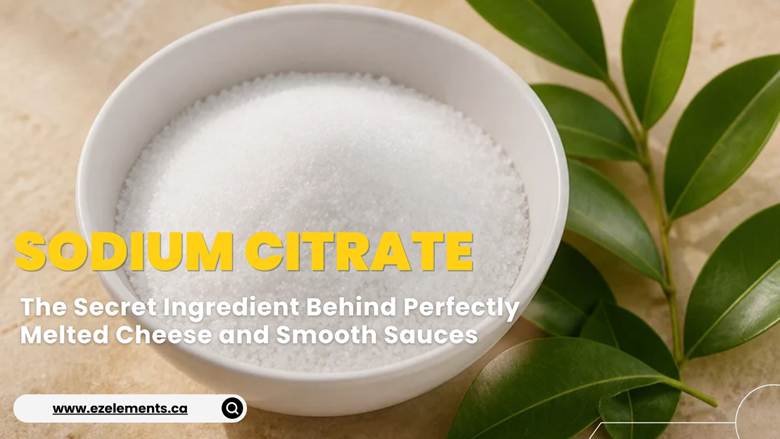
Sodium Citrate is the sodium salt of citric acid, a naturally occurring organic acid found in citrus fruits. It is produced by neutralizing food-grade citric acid with sodium hydroxide or sodium carbonate, yielding a white, free-flowing crystalline powder with a mild salty, slightly sour taste. Its chemical formula is Na3C6H5O7, its food additive code is E331, and its CAS number is 68-04-2. EZ Elements supplies Sodium Citrate in a 30/100 mesh particle size specification, a granulation range chosen specifically for the dissolution speed and handling characteristics food manufacturers need in cheese, sauce, and beverage production.
Sodium Citrate belongs to a category of food ingredients known as emulsifying salts, and it is the most widely recognized member of that small but technically important group. It is the ingredient that makes a humble box of processed cheese melt into something perfectly smooth and pourable, and it is the same ingredient food technologists reach for whenever a sauce, dip, or beverage threatens to separate, curdle, or turn grainy under heat. Despite sounding like a complicated chemical, Sodium Citrate is simply the salt form of an acid found naturally in lemons and limes, and it has earned a permanent place in both industrial food manufacturing and the modern home kitchen for one very specific reason: it solves the cheese-melting problem better than almost anything else.
How Sodium Citrate Creates Perfectly Melted Cheese
To understand why Sodium Citrate works so well, it helps to understand what actually happens, structurally, when cheese melts. Cheese is an emulsion: tiny droplets of fat suspended in a watery protein matrix, held together by a network of casein proteins that are in turn linked to each other by calcium ions. When cheese is heated normally, the fat melts and the protein network loosens, but the calcium bonds holding the proteins together do not loosen evenly. The result, especially with aged or naturally lower-moisture cheeses, is a melt that breaks: the fat oozes out separately, the proteins clump into a tight, rubbery mass, and the whole thing looks greasy, stringy, or grainy instead of smooth.
Sodium Citrate solves this by acting as a calcium chelator and emulsifying salt. As the cheese is heated in the presence of Sodium Citrate, the sodium ions in the citrate compound essentially swap places with some of the calcium ions holding the casein protein network together. This loosens the protein structure in a controlled way, freeing the proteins to act as active emulsifiers again rather than clumping. The proteins then re-coat the fat droplets and bind them into the surrounding liquid, creating a single, stable, smooth emulsion instead of a separated mess. The result is the same oozy, stretchy, glossy melt found in commercial products like Velveeta and American cheese, and it works on almost any cheese, including aged cheddars and other varieties that do not melt well on their own.
This same emulsifying mechanism is exactly why Sodium Citrate shows up in fondues, nacho cheese sauces, mac and cheese, and queso dips: it is not adding flavor, it is rebuilding the emulsion that heat would otherwise destroy.
Key Features & Benefits
- Functions as a powerful emulsifying salt, chelating calcium ions in dairy proteins to prevent fat and protein separation during heating and melting.
- Produces a smooth, stable, lump-free cheese melt across a wide range of cheese types, including aged and naturally low-melting varieties that would otherwise separate or turn grainy.
- Acts as a buffering agent, regulating pH in beverages, sauces, and dairy products to maintain consistent flavor, texture, and stability throughout shelf life.
- Mild, salty, slightly sour flavor profile that is virtually undetectable at the low concentrations used in food formulation, with no impact on the overall taste of the finished product.
- GRAS classified by the FDA and approved internationally as food additive E331, with an extensive and well-documented history of safe use across processed cheese, beverage, and confectionery manufacturing.
- Highly water-soluble, dissolving readily into both hot and cold liquid systems, supported by the 30/100 mesh particle size specification chosen for efficient, even dispersion in production environments.
- Compatible with other food acids and stabilizers, including citric acid, sodium bicarbonate, and hydrocolloids, allowing formulators to fine-tune texture, pH, and mouthfeel in combination.
Applications
Sodium Citrate (30/100 Mesh) is used across multiple industry categories served by EZ Elements, with cheese and sauce manufacturing as its single most recognizable application.
- Processed and pasteurized cheese products, including cheese slices, cheese spreads, and block process cheese, where it is the primary emulsifying salt responsible for smooth, consistent melting and slicing properties
- Cheese sauces, nacho cheese, queso dips, mac and cheese products, and fondues, where it prevents the fat and protein separation that causes grainy or oily texture during heating
- Carbonated and non-carbonated beverages, where it functions as a buffering agent to control acidity and stabilize flavor throughout shelf life
- Confectionery products, including gummy candies and fruit-flavored sweets, where it helps regulate pH and supports texture and gel-setting consistency
- Canned and jarred foods, where its buffering properties help maintain flavor balance and product stability
- Effervescent food and beverage products, where it can be combined with an acid and a carbonate or bicarbonate source to support controlled fizzing reactions
- Ice cream and frozen dairy desserts, where it can assist with protein stabilization and texture consistency during freezing and storage
- Bath bombs and effervescent personal care products, where it can be used alongside citric acid and sodium bicarbonate to fine-tune fizzing reaction speed and pH
- Skin care and cosmetic formulations as a mild buffering and chelating agent supporting formulation stability
- Oral pharmaceutical formulations, including effervescent tablets and powders, where it functions as a buffering and alkalizing agent
- Anticoagulant applications in blood collection tubes and certain medical preparations, where its calcium-chelating properties prevent clotting
- Pet food and treat formulations, where it can assist with pH regulation and texture consistency in moist and semi-moist products
- Water-softening and chelating applications in cleaning formulations, where its ability to bind calcium and magnesium ions improves the performance of surfactants in hard water
- Industrial water treatment and metal-cleaning applications, leveraging its calcium and metal-ion chelating properties
Technical Specifications
| Property | Specification |
| INCI Name | Sodium Citrate |
| CAS No. | 68-04-2 |
| Chemical Formula | Na3C6H5O7 |
| Food Additive Code | E331 |
| Common Name | Sodium Citrate, Trisodium Citrate, Citrate of Soda |
| Particle Size | 30/100 Mesh (selected for dissolution speed and handling in cheese and beverage production) |
| Appearance | White, free-flowing crystalline powder or granules |
| Taste | Mildly salty with a slightly sour, citrus-like note |
| Assay (Purity) | 99.0% minimum (food grade) |
| pH (5% Solution) | 7.5 to 9.0 (mildly alkaline buffering agent) |
| Solubility | Freely soluble in water; dissolves readily in both hot and cold liquid systems |
| Typical Use Level (Cheese Sauce) | Approximately 2.0% to 3.0% of total liquid plus cheese weight |
| Origin | Citric acid (naturally occurring in citrus fruits) neutralized with sodium hydroxide or sodium carbonate |
| Regulatory Status | GRAS (FDA); E331 (EU); accepted in major international food regulatory frameworks |
Why Choose EZ Elements as Your Supplier
EZ Elements supplies food-grade Sodium Citrate (30/100 Mesh) with consistent particle size, verified purity, and complete documentation to support cheese manufacturers, sauce and condiment producers, beverage companies, and confectionery makers across Canada.
- Full documentation including Technical Data Sheet (TDS), Certificate of Analysis (COA), and Safety Data Sheet (SDS)
- Food-grade specification with consistent 30/100 mesh particle size for reliable dissolution and handling performance
- Bulk supply with transparent, competitive pricing per kilogram across all pack sizes
- Technical support on emulsifying salt use levels, cheese-melting formulation guidance, and beverage and sauce buffering applications
Safety & Storage Guidelines
- Store in a cool, dry, well-ventilated area away from direct sunlight, moisture, and heat sources.
- Keep containers tightly sealed after use to prevent moisture absorption and caking of the crystalline powder.
- Use within recommended formulation concentrations, as excessive use can introduce a noticeable salty or sour flavor to the finished product.
- Sodium Citrate can be a mild eye and skin irritant in concentrated powder form; wear standard protective equipment when handling in bulk.
- Shelf life is typically 2 years from manufacture date when stored correctly in sealed, cool, and dry conditions.
Complete handling, first aid, and disposal instructions are provided in the Safety Data Sheet (SDS) available from EZ Elements upon request.
Frequently Asked Questions
Q1: Why is Sodium Citrate called the secret ingredient behind melted cheese?
Because it solves a structural problem that ordinary heat cannot fix on its own. Cheese is held together by a network of proteins linked by calcium ions. When heated normally, the fat melts faster than the protein network loosen evenly, which causes the fat to ooze out separately while the proteins clump into a tight, greasy, or grainy mass. Sodium Citrate works by swapping sodium ions for some of the calcium holding the protein network together, loosening the structure in a controlled way so the proteins can re-emulsify the fat and water into one smooth, stable mixture. This is the exact mechanism behind the smooth, pourable melt of products like Velveeta and American cheese, and it is why a small amount of Sodium Citrate can make almost any cheese, including aged varieties that normally melt poorly, turn into a silky cheese sauce.
Q2: How much Sodium Citrate should be used in a cheese sauce?
In commercial and home cheese sauce formulation, Sodium Citrate is typically used at approximately 2.0% to 3.0% of the combined weight of the liquid and cheese in the recipe. Because Sodium Citrate has a mildly salty, slightly sour taste, food technologists need to be precise with this proportion: too little will not achieve full emulsification, while too much can introduce an off-flavor to the finished sauce. A 2006 dairy science study found that very low concentrations, around 0.25%, were insufficient to achieve the desired emulsifying effect, reinforcing why precision in dosing is essential for consistent commercial results.
Q3: Can Sodium Citrate be used with any type of cheese?
Yes, in general Sodium Citrate works across a very wide range of cheese types, including aged cheddar, Monterey Jack, gouda, and many other varieties that do not melt smoothly on their own. This is precisely why it has become a favorite technique among home cooks and food technologists alike for transforming nearly any cheese into a smooth, pourable sauce. For applications requiring a firmer, sliceable finished product rather than a pourable sauce, some formulators combine Sodium Citrate with a second emulsifying salt, such as sodium hexametaphosphate, which improves the firmness and slicing properties of the cooled cheese while Sodium Citrate continues to provide the primary emulsification.
Q4: Is Sodium Citrate only used in cheese, or does it work in other smooth sauces too?
Sodium Citrate’s usefulness extends well beyond cheese. Its core function as a buffering and emulsifying agent makes it valuable anywhere a sauce, dip, or beverage needs to maintain a smooth, stable consistency under heat or through a long shelf life, including beverages requiring acidity control, confectionery products needing pH regulation for proper texture and set, and various sauces and condiments where preventing separation is a quality priority. The same chelating and buffering chemistry that smooths a cheese sauce is at work in many of these other applications, even though the cheese-melting use case is by far its most well-known and visible function.
Q5: Is Sodium Citrate safe to eat?
Yes. Sodium Citrate is GRAS classified by the FDA and approved internationally as food additive E331, with an extensive history of safe use in processed cheese, beverages, and confectionery manufacturing. It is simply the sodium salt of citric acid, an acid that occurs naturally in citrus fruits, and the body processes it without difficulty at the concentrations used in food. It is even an ingredient in some over-the-counter effervescent medications. As with any food ingredient, manufacturers should use it within standard food industry concentration guidelines for their specific product category.
Q6: Where can I buy food-grade Sodium Citrate in bulk in Canada?
Food-grade Sodium Citrate (30/100 Mesh) is available for bulk purchase directly from EZ Elements, with supply options for cheese manufacturers, sauce and condiment producers, beverage companies, and confectionery makers across Canada. Contact our team for current pricing, documentation, and product samples.
Related Ingredients
The following EZ Elements ingredients are commonly used alongside Sodium Citrate in food and beverage formulation:
- Citric Acid (Anhydrous) USP/Kosher The parent acid of Sodium Citrate, frequently used together for fine-tuning pH, flavor balance, and effervescent reactions in beverages, confectionery, and bath products.
- Sodium Bicarbonate (Baking Soda) USP/Kosher A common companion in effervescent food and beverage formulations, reacting with Sodium Citrate-adjacent acids to produce controlled carbon dioxide release.
- Kappa Carrageenan A natural gelling and stabilizing agent used alongside Sodium Citrate in dairy and plant-based cheese alternative formulations requiring both emulsification and texture-setting performance.
Order or Enquire
Looking to buy food-grade Sodium Citrate in bulk? Contact EZ Elements for current pricing, full product documentation, and supply options across food and beverage manufacturing. We supply cheese producers, sauce and condiment makers, and beverage manufacturers across Canada. Reach out today to request a sample, Technical Data Sheet, or a bulk pricing quote for your next formulation project.