Product Overview
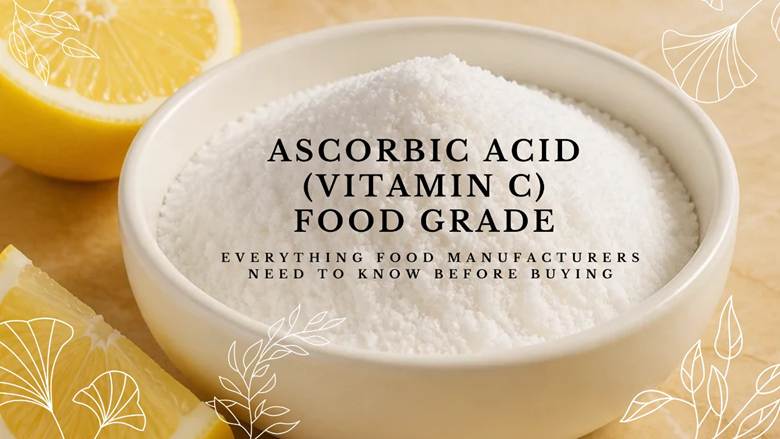
Ascorbic Acid, universally recognized as Vitamin C, is a water-soluble organic acid with the chemical formula C6H8O6. It occurs naturally in citrus fruits, berries, and leafy vegetables and is commercially produced through the fermentation of glucose, yielding a white to slightly yellow crystalline powder of high purity. Its INCI name is Ascorbic Acid, its internationally recognized food additive code is E300, and its CAS number is 50-81-7.
EZ Elements supplies Ascorbic Acid in food-grade specification, meeting FDA GRAS status, FCC (Food Chemicals Codex), and international E300 food additive standards. For food manufacturers across Canada, Ascorbic Acid is one of the most indispensable multi-functional ingredients available — simultaneously serving as an antioxidant preservative, nutritional fortifier, dough conditioner, color stabilizer, and pH modifier across a wide spectrum of food and beverage product categories. Its outstanding water solubility, well-established safety record, and broad regulatory acceptance make it a first-choice ingredient for both large-scale food manufacturers and small artisan food businesses.
Key Features & Benefits
- Food-grade specification meeting FDA GRAS status, FCC standards, and E300 international food additive approval for direct use in food and beverage products.
- Powerful antioxidant that inhibits oxidative degradation in food formulations, extending product shelf life and protecting color, flavor, and nutritional quality.
- Dough conditioner and flour improver in baking applications — strengthens gluten network, improves dough stability, and produces better oven spring and crumb structure.
- Highly water-soluble (330 g/L at 20 degrees C) enabling easy and complete dissolution into water-phase food formulations without residue or undissolved particles.
- Prevents enzymatic and non-enzymatic browning in cut fruits, vegetables, juices, and processed food products, maintaining natural fresh appearance through the supply chain.
- Nutrient fortification active providing measurable Vitamin C content claims on food and beverage product labels, supporting immune health and wellness product positioning.
- Synergistic antioxidant activity alongside Vitamin E, rosemary extract, and other natural antioxidants for enhanced food preservation performance in complex formulations.
Applications
Ascorbic Acid Food Grade serves food and beverage manufacturers as its primary application, with additional uses across personal care, pharmaceutical, pet care, industrial, and cleaning sectors.
- Antioxidant and preservative in fruit juices, soft drinks, energy drinks, and carbonated beverages to prevent oxidation, maintain color, and extend shelf life (E300)
- Dough conditioner and flour treatment agent in commercial bread baking, strengthening gluten structure, improving dough extensibility, and enhancing final loaf volume and texture
- Color retention and anti-browning agent in fresh-cut fruit and vegetable processing, canned goods, and frozen food production to preserve natural appearance
- Vitamin C fortification of breakfast cereals, infant formula, fruit beverages, dairy products, snack bars, and functional food formulations supporting nutrient content claims
- Preservative in cured and processed meats, sausage formulations, and fish products to prevent oxidative rancidity and inhibit nitrosamine formation
- Acidulant and sour flavor enhancer in confectionery, gummy candies, sour coatings, and fruit-flavored food product formulations
- Synergistic preservative in combination with other food-grade antioxidants including rosemary extract and tocopherols in clean-label preservation systems
- Effervescent tablet and instant beverage powder formulations where it reacts with sodium bicarbonate to create CO2 fizzing upon dissolution
- Skin-brightening and antioxidant active in vitamin C facial serums, anti-aging creams, and hyperpigmentation treatment formulations
- pH adjuster and acidulant in cosmetic toners, exfoliating treatments, and acid-based personal care products
- Effervescent reactive agent in bath bomb formulations when combined with Sodium Bicarbonate to produce the characteristic fizzing effect
- Antioxidant stabilizer protecting other actives and oil phases in natural and clean beauty personal care formulations
- Vitamin C dietary supplement in tablets, capsules, chewables, effervescent tablets, and liquid formulations for immune health and antioxidant support
- Antioxidant excipient in injectable pharmaceutical preparations protecting oxygen-sensitive active pharmaceutical ingredients from oxidative degradation
- Treatment and prevention of Vitamin C deficiency and scurvy in clinical and nutraceutical pharmaceutical applications
- Iron absorption enhancement supplement formulations for non-heme iron deficiency treatment
- Antioxidant additive in pet food formulations protecting fats, fat-soluble vitamins, and sensitive nutrients from oxidative rancidity during processing and storage
- Essential dietary supplement for guinea pigs, rabbits, and other small animals that cannot synthesize their own Vitamin C endogenously
- Companion animal health supplement targeting immune support, joint health, and antioxidant protection in dog and cat nutraceutical formulations
- Water dechlorination and purification agent neutralizing chlorine and chloramines in potable water treatment and aquarium water preparation
- Reducing agent in polymer, rubber, and plastic manufacturing processes requiring controlled reduction chemistry
- Pool and spa stain removal treatment leveraging chelating and reducing properties to dissolve iron and mineral stains from pool surfaces
- Descaling and mild acid cleaning agent for food contact surfaces and food processing equipment where a food-safe, biodegradable acid cleaner is specified
- Water treatment additive removing chlorine taste and odor from potable water in institutional and commercial food service water systems
Technical Specifications
| Property | Specification |
| INCI Name | Ascorbic Acid |
| CAS No. | 50-81-7 |
| Chemical Formula | C6H8O6 |
| Food Additive Code | E300 |
| Common Name | Vitamin C, L-Ascorbic Acid |
| Appearance | White to slightly yellow crystalline powder |
| Assay (Purity) | 99.0% to 100.5% (Food Grade / USP / FCC specification) |
| pH (5% Solution) | 2.1 to 2.6 (acidic) |
| Solubility | Freely soluble in water (330 g/L at 20 degrees C); sparingly soluble in ethanol |
| Molecular Weight | 176.12 g/mol |
| Melting Point | 190 degrees C (decomposes above this temperature) |
| Heavy Metals | Maximum 10 ppm (Food Grade) |
| Origin | Fermentation of glucose; primarily from corn-derived glucose sources |
| Recommended Use Level | 0.005% to 0.1% in food (regulatory limits by application); 0.5% to 20% in personal care |
| Regulatory Status | GRAS (FDA); E300 (EU); accepted in USP, BP, EP, and FCC |
Why Choose EZ Elements as Your Supplier
EZ Elements supplies food-grade Ascorbic Acid with verified purity, consistent batch quality, and complete documentation to support food manufacturers, beverage producers, bakeries, and natural food brands across Canada and North America.
We serve food and beverage manufacturers, personal care brands, pharmaceutical formulators, and pet food producers, providing:
- Full documentation including Technical Data Sheet (TDS), Certificate of Analysis (COA), and Safety Data Sheet (SDS)
- Food-grade specification with assay 99.0% to 100.5% meeting FDA GRAS, EU E300, and FCC requirements
- Bulk supply with transparent, competitive pricing per kilogram — available in multiple pack sizes for small businesses and large manufacturers
- Technical support on use levels, pH management, stability optimization, and compatibility with other food ingredients and preservative systems
Safety & Storage Guidelines
- Store in a cool, dry, dark location away from direct sunlight, moisture, heat, and oxidizing materials — Ascorbic Acid is sensitive to light, heat, and oxygen exposure.
- Keep containers tightly sealed after each use to prevent oxidative degradation, which turns the powder yellow or orange and indicates loss of potency.
- Important formulation warning: Do not combine with Sodium Benzoate in water-based formulations — this combination can produce benzene under certain pH and temperature conditions.
- Wear protective gloves when handling in bulk quantities; the powder is mildly acidic and may cause mild skin irritation with prolonged contact.
- Shelf life is typically 2 years from manufacture date when stored correctly in sealed, cool, dark, and dry conditions.
Complete handling, first aid, and disposal instructions are provided in the Safety Data Sheet (SDS) available from EZ Elements upon request.
Frequently Asked Questions
Q1: What is Ascorbic Acid used for in food manufacturing?
In food manufacturing, Ascorbic Acid (Vitamin C) serves multiple critical functions simultaneously. It acts as an antioxidant preservative protecting against oxidative spoilage and color degradation in beverages, juices, and processed foods. It functions as a dough conditioner in commercial baking, strengthening gluten structure and improving bread volume and texture. It is used as a color retention agent preventing browning in fresh-cut produce and canned vegetables. It fortifies food products with measurable Vitamin C for nutritional labeling, and it enhances sour flavor profiles in confectionery and beverage applications.
Q2: Is food-grade Ascorbic Acid the same as pharmaceutical-grade Vitamin C?
Food-grade and pharmaceutical-grade Ascorbic Acid share the same molecule and nearly identical purity specifications — both typically requiring 99.0% to 100.5% assay. The primary differences lie in the testing requirements and regulatory compliance documentation. Pharmaceutical-grade must meet pharmacopeial monograph specifications (USP, BP, EP) with additional testing for pharmaceutical-specific impurities. Food-grade meets FDA GRAS and FCC standards. For most food manufacturing and personal care applications, food-grade Ascorbic Acid is fully appropriate and cost-effective.
Q3: Why should Ascorbic Acid not be combined with Sodium Benzoate?
When Ascorbic Acid and Sodium Benzoate are present together in an acidic, water-based formulation, a chemical reaction can occur that produces benzene — a known human carcinogen. This reaction is of greatest concern in soft drinks and acidic water-based food formulations. Food manufacturers and formulators should avoid combining these two ingredients in the same water-phase product. If both preservation functions are needed, alternative preservation systems or formulation strategies should be used, and thorough stability testing should confirm that benzene levels remain below regulatory safety thresholds.
Q4: What is the recommended use level of Ascorbic Acid in baked goods?
In commercial bread baking as a dough conditioner and flour improver, Ascorbic Acid is typically used at very low concentrations of 10 to 200 parts per million (0.001% to 0.02%) of total flour weight. At these concentrations, it strengthens the gluten network through its oxidizing action, improves dough stability during machining, and produces better oven spring and final loaf volume. As an antioxidant preservative in baked goods, slightly higher concentrations may be used within regulatory limits. Always verify the applicable maximum permitted level for your specific food category and target market.
Q5: Can Ascorbic Acid be used to prevent browning in fresh-cut fruits and vegetables?
Yes. Ascorbic Acid is one of the most widely used agents for preventing enzymatic browning in fresh-cut apples, avocados, potatoes, mushrooms, and other produce prone to oxidative discoloration. It acts as a competitive inhibitor of the polyphenol oxidase enzyme responsible for browning, and as an antioxidant that scavenges the oxygen driving the reaction. It is typically applied as a dilute aqueous solution dip or spray at concentrations of 0.5% to 2%, either alone or in combination with citric acid for enhanced effect and pH adjustment.
Q6: Where can I buy food-grade Ascorbic Acid in bulk in Canada?
Food-grade Ascorbic Acid (Vitamin C) is available for bulk purchase directly from EZ Elements, with supply options for food manufacturers, beverage producers, bakeries, supplement makers, personal care brands, and pet food producers across Canada and North America. Contact our team for current pricing, documentation, and product samples.
Related Ingredients
The following EZ Elements ingredients are commonly used alongside Ascorbic Acid in food, personal care, and preservation formulations:
- Citric Acid (Anhydrous) — Works synergistically with Ascorbic Acid as a pH adjuster and chelating agent in food preservation systems; commonly combined for enhanced anti-browning and antioxidant performance in juices and beverages.
- Sodium Benzoate — Important compatibility note: Sodium Benzoate must NOT be combined with Ascorbic Acid in water-based formulations due to potential benzene formation. Use alternative preservation combinations when both are needed.
- Sodium Bicarbonate (Baking Soda) — Reacts with Ascorbic Acid in effervescent tablet, instant beverage, and bath product formulations; the two are commonly co-formulated as dry blends that activate upon water contact.
Order or Enquire
Looking to buy Ascorbic Acid (Vitamin C) Food Grade in bulk? Contact EZ Elements for current pricing, full product documentation, and supply options across food and beverage, personal care, pharmaceutical, and pet care applications. We supply brands, manufacturers, and formulators across Canada and North America. Reach out today to request a sample, Technical Data Sheet, or a bulk pricing quote.