Product Overview
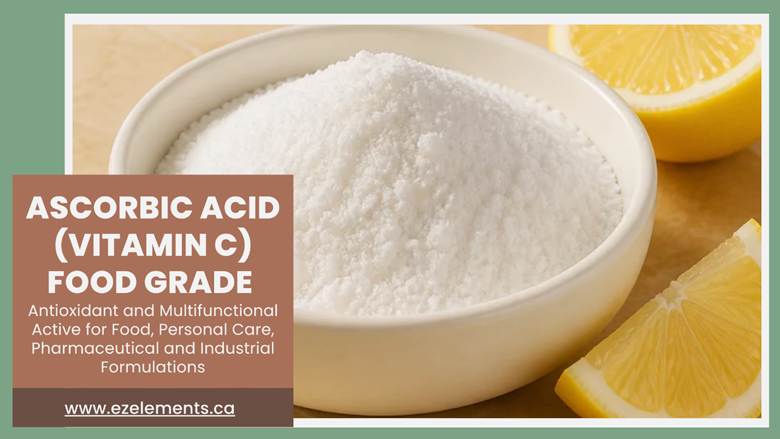
Ascorbic Acid, universally recognized as Vitamin C, is a water-soluble, naturally occurring organic acid and essential human micronutrient with the chemical formula C6H8O6. It is found abundantly in fresh fruits and vegetables including citrus, strawberries, peppers, and broccoli. Commercially, Ascorbic Acid is produced through the fermentation of glucose followed by chemical oxidation, yielding a white to slightly yellow crystalline powder of high purity. Its INCI name is Ascorbic Acid, its food additive designation is E300, and its CAS number is 50-81-7.
EZ Elements supplies Ascorbic Acid in food-grade specification, meeting FDA GRAS status and international food additive standards. Food-grade Ascorbic Acid is also widely used in personal care formulations, pharmaceutical applications, pet care and animal nutrition, and certain industrial processes. Its powerful antioxidant activity, excellent water solubility, mild acidity, and well-established safety profile across all these sectors make it one of the most broadly applicable ingredient actives available. Importantly, formulators using Ascorbic Acid in personal care should be aware that it should not be combined with Sodium Benzoate in water-based formulations, as this combination can produce benzene under certain conditions.
Key Features & Benefits
- Powerful antioxidant that inhibits oxidative degradation in food, cosmetic, and pharmaceutical formulations, extending product shelf life and protecting sensitive actives.
- Food-grade specification meeting FDA GRAS status and E300 international food additive approval for direct use in food and beverage applications.
- Skin-brightening and collagen-synthesis-supporting active in personal care formulations — one of the most researched topical skincare ingredients available.
- Reduces oxidative browning and color degradation in food processing, helping maintain the natural appearance of fruits, vegetables, and processed foods.
- Highly water-soluble (330 g/L at 20 degrees C) and easily incorporated into water-phase formulations across food, pharmaceutical, and cosmetic applications.
- Essential nutritional supplement active — required for immune function, collagen synthesis, and iron absorption in human and animal physiology.
- Functions as a reducing agent, pH adjuster, and chemical intermediate across industrial applications including water purification and polymer manufacturing.
Applications
Ascorbic Acid Food Grade is used across six industry categories served by EZ Elements.
- Antioxidant and preservative in fruit juices, soft drinks, and beverages to prevent oxidation, maintain color, and extend shelf life (E300)
- Dough conditioner and flour improver in bread and baked goods manufacturing, strengthening gluten structure and improving dough stability
- Color retention agent in processed fruits, vegetables, and canned goods to prevent enzymatic browning during processing and storage
- Vitamin C fortification of cereals, dairy products, fruit drinks, infant formula, and functional beverages
- Preservative in cured meats, processed fish, and sausage formulations to prevent oxidative rancidity and nitrosamine formation
- Acidulant and flavor enhancer in confectionery, gummy products, and sour candy formulations
- Skin-brightening active in facial serums, vitamin C serums, and anti-aging formulations targeting hyperpigmentation and uneven skin tone
- Collagen synthesis stimulator in anti-aging creams, peptide serums, and skin renewal formulations
- Antioxidant stabilizer in cosmetic formulations protecting other actives and the formulation base from oxidative degradation
- pH adjuster and acidulant in personal care formulations including toners, exfoliants, and acid-based treatments
Effervescent reactive agent in bath bomb and bath tablet formulations when combined with Sodium Bicarbonate (Baking Soda) — note: these must be kept as dry components until water contact.
- Stabilizing and antioxidant role in natural and clean beauty formulations protecting plant-derived actives from oxidation
- Vitamin C dietary supplement active in tablets, capsules, chewable, effervescent tablets, and liquid supplement formulations
- Antioxidant excipient in injectable pharmaceutical formulations protecting oxygen-sensitive active pharmaceutical ingredients
- Treatment and prevention of scurvy and Vitamin C deficiency in clinical pharmaceutical applications
- Supportive therapy in iron deficiency anaemia treatment, enhancing non-heme iron absorption from food and supplement sources
- Antioxidant stabilizer in topical pharmaceutical preparations protecting active molecules from degradation
- Immune health and antioxidant support formulations in nutraceutical and functional health supplement manufacturing
- Antioxidant additive in pet food and animal feed formulations protecting fats and fat-soluble vitamins from oxidative rancidity
- Nutritional supplement active in companion animal (dog, cat) health supplements targeting immune support and joint health
- Vitamin C fortification in guinea pig, rabbit, and other small animal feed where these species cannot synthesize their own Vitamin C
- Antioxidant preservative in moist pet food and semi-moist treat formulations extending shelf life naturally
- Active ingredient in veterinary nutraceutical formulations for skin, coat, and immune health support
- Water purification and dichlorination agent — Ascorbic Acid neutralizes chlorine and chloramines in potable water treatment systems
- Photographic developer and reducing agent in film and print processing chemistry (now primarily historical but still used in specialty applications)
- Reducing agent in polymer and plastic manufacturing processes where controlled reduction reactions are required
- Analytical chemistry reducing agent in laboratory titration and chemical analysis applications
- Rust and metal stain removal agent leveraging its chelating and reducing properties for pool stain treatment and surface preparation
- Pool and spa stain remover — Ascorbic Acid effectively dissolves iron and mineral stains on pool surfaces through chelation and reduction
- Water treatment additive for removing chlorine taste and odour from potable water in institutional and commercial water systems
- Descaling and mild acid cleaning agent in food contact surface and equipment cleaning where a food-safe acid is required
Technical Specifications
| Property | Specification |
| INCI Name | Ascorbic Acid |
| CAS No. | 50-81-7 |
| Chemical Formula | C6H8O6 |
| Common Name | Vitamin C, L-Ascorbic Acid, Ascorbic Acid |
| Food Additive Code | E300 |
| Appearance | White to slightly yellow crystalline powder |
| Assay (Purity) | 99.0% to 100.5% (Food Grade / USP specification) |
| pH (5% Solution) | 2.1 to 2.6 (acidic) |
| Solubility | Freely soluble in water (330 g/L at 20 degrees C); sparingly soluble in ethanol |
| Molecular Weight | 176.12 g/mol |
| Melting Point | 190 degrees C (decomposes above this temperature) |
| Specific Optical Rotation | +20.5 to +21.5 degrees (USP) |
| Heavy Metals | Maximum 10 ppm (Food Grade) |
| Origin | Fermentation of glucose followed by chemical oxidation; primarily from corn-derived glucose |
| Recommended Use Level | Variable by application; 0.5% to 20% in personal care; 0.005% to 0.1% in food |
| Regulatory Status | GRAS (FDA); E300 (EU food additive); accepted in USP, BP, EP, and FCC |
Why Choose EZ Elements as Your Supplier
EZ Elements supplies food-grade Ascorbic Acid with verified purity, consistent quality, and complete documentation to support manufacturing across food and beverage, personal care, pharmaceutical, pet care, industrial, and cleaning applications in Canada and North America.
We supply food manufacturers, personal care brands, pharmaceutical formulators, pet food producers, and industrial clients, providing:
- Full documentation including Technical Data Sheet (TDS), Certificate of Analysis (COA), and Safety Data Sheet (SDS)
- Food-grade specification with assay 99.0% to 100.5% meeting FDA, EU E300, and FCC requirements
- Bulk supply with transparent, competitive pricing per kilogram across all pack sizes
- Technical support on formulation uses levels, stability management, pH considerations, and compatibility guidance across all industries
Safety & Storage Guidelines
- Store in a cool, dry, dark location away from direct sunlight, moisture, heat, and oxidizing materials — Ascorbic Acid is sensitive to light, heat, and oxygen.
- Keep containers tightly sealed after each use to prevent oxidative degradation and moisture absorption.
- Do not combine with Sodium Benzoate in water-based formulations — this combination can produce benzene under certain pH and temperature conditions.
- Wear protective gloves when handling in bulk quantities; the powder is mildly acidic and can cause mild skin irritation with prolonged contact.
- Avoid inhalation of fine Ascorbic Acid powder dust when handling large quantities in production environments.
- Shelf life is typically 2 years from manufacture date when stored correctly in sealed, cool, dark, and dry conditions.
Complete handling, first aid, and disposal instructions are provided in the Safety Data Sheet (SDS) available from EZ Elements upon request.
Frequently Asked Questions
Q1: Which industries use Ascorbic Acid Food Grade?
Ascorbic Acid Food Grade is used across six industries: Food and Beverages (antioxidant preservative, vitamin C fortification, dough conditioner, color retention), Personal Care (skin-brightening serum active, collagen synthesis stimulator, antioxidant stabilizer, bath bomb acid component), Pharmaceutical (dietary supplement active, injectable antioxidant excipient, scurvy treatment, iron absorption enhancer), Pet Care (animal feed antioxidant, companion animal supplement, guinea pig and rabbit vitamin C fortification), Industrial (water dichlorination, photographic reducing agent, polymer manufacturing, rust removal), and Cleaning and Sanitation (pool stain remover, water chlorine removal, food-safe descaling acid).
Q2: Is food-grade Ascorbic Acid the same as pharmaceutical-grade Vitamin C?
Food-grade and pharmaceutical-grade Ascorbic Acid share the same molecule and nearly identical chemical specifications — both typically require 99.0% to 100.5% assay purity. The primary differences are in the testing requirements, documentation, and regulatory compliance framework. Pharmaceutical-grade Ascorbic Acid must meet the specific monograph requirements of pharmacopeias such as USP, BP, or EP, with additional testing for specific impurities relevant to pharmaceutical manufacturing. Food-grade material meets FDA GRAS and FCC specifications. For most personal care and food applications, food-grade Ascorbic Acid is fully appropriate. For pharmaceutical dosage forms and injectables, pharmaceutical-grade with pharmacopeial compliance documentation should be used.
Q3: Why should Ascorbic Acid not be combined with Sodium Benzoate in formulations?
When Ascorbic Acid and Sodium Benzoate are present together in an acidic, water-based formulation, a chemical reaction can occur that produces benzene — a known human carcinogen. This reaction is of greatest concern in acidic aqueous products such as soft drinks or water-based cosmetics. Formulators should avoid combining these two ingredients in the same water phase. If both are needed for a formulation, alternative preservation systems should be considered, or thorough stability testing should be conducted to confirm that benzene levels remain below regulatory safety thresholds.
Q4: How is Ascorbic Acid used in vitamin C serums for skin care?
In personal care formulations, L-Ascorbic Acid is the biologically active, most potent form of Vitamin C for topical skin brightening and collagen support. It is typically used at concentrations of 5% to 20% in water-based serums formulated at a low pH of approximately 2.5 to 3.5, where it remains stable and maximally bioavailable for skin absorption. At higher pH, Ascorbic Acid oxidizes rapidly, losing efficacy. Stability is a critical formulation challenge — Ascorbic Acid is prone to oxidation from light, heat, and air exposure, turning the serum yellow or orange as it degrades. Formulators address this through anhydrous formulations, antioxidant synergists such as Vitamin E and ferulic acid, and opaque, nitrogen-flushed packaging.
Q5: Is Ascorbic Acid safe for use in pet food and animal supplements?
Yes. Ascorbic Acid is widely recognized as safe and beneficial in pet food and animal nutrition applications. It is an approved feed additive antioxidant for protecting fats and fat-soluble nutrients in animal feed from oxidative rancidity. It is particularly important as a dietary supplement for guinea pigs, rabbits, and some primate species that, like humans, cannot synthesize their own Vitamin C endogenously and require dietary sources. For dogs and cats, it is used as a supplement and feed additive antioxidant. Formulators should use the appropriate food-grade or feed-grade material and verify compliance with applicable feed additive regulations for their target animal species and market.
Q6: Where can I buy Ascorbic Acid (Vitamin C) Food Grade in bulk in Canada?
Ascorbic Acid Food Grade is available for bulk purchase directly from EZ Elements, with supply options for food manufacturers, personal care brands, pharmaceutical formulators, pet food producers, and industrial clients across Canada and North America. Contact our team for current pricing, documentation, and product samples.
Related Ingredients
The following EZ Elements ingredients are commonly used alongside Ascorbic Acid in personal care, food, and pharmaceutical formulations:
- Sodium Bicarbonate (Baking Soda) — Reacts with Ascorbic Acid in bath bomb and effervescent tablet formulations to produce CO2 fizzing; also used alongside Ascorbic Acid in food and pharmaceutical pH management applications.
- Sodium Benzoate — Important compatibility note: Sodium Benzoate should NOT be combined with Ascorbic Acid in water-based formulations due to potential benzene formation. When both are needed, alternative preservation systems should be selected.
- Aloe Vera Juice — Natural soothing botanical frequently used alongside Ascorbic Acid in personal care serums and toners, where aloe provides hydration and skin calming to complement the brightening and antioxidant action of Vitamin C.
Order or Enquire
Looking to buy Ascorbic Acid (Vitamin C) Food Grade in bulk? Contact EZ Elements for current pricing, full product documentation, and supply options across food and beverage, personal care, pharmaceutical, pet care, industrial, and cleaning applications. We supply brands, formulators, and manufacturers across Canada and North America. Reach out today to request a sample, Technical Data Sheet, or a bulk pricing quote for your next project.