Ever noticed a hazy streak lingering on a freshly wiped window, or chalky white rings drying across the hood of a newly washed car? Even when a cleaning formula is built with high-performance surfactants, invisible enemies in local tap water—dissolved calcium, magnesium, and iron ions—quietly hijack the wash. They bind to active surfactants, flatten lather, and leave behind stubborn mineral residue on glass, finished floors, and automotive paint.
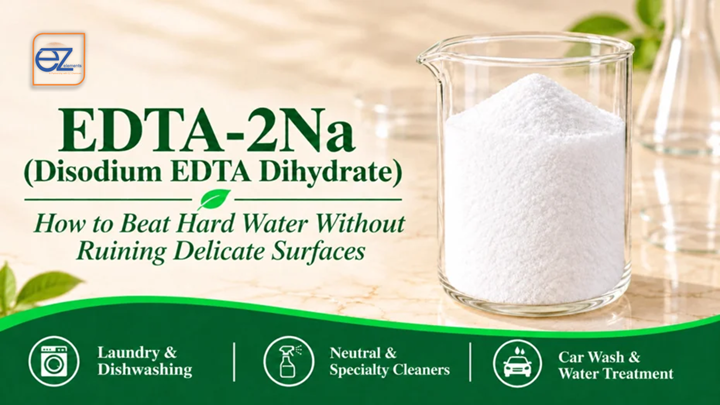
EDTA-2Na (Disodium EDTA Dihydrate) stops that interference at the molecular level. Supplied as a free-flowing white crystalline powder, this water-soluble chelating agent acts like a microscopic claw, locking stray metal ions into stable, rinseable complexes so your surfactants can focus entirely on lifting soil—without spiking your formula’s pH.
Two Formulations Where EDTA-2Na Outperforms High-pH Chelators
In neutral and specialty surface cleaners, alkalinity is a double-edged sword: most heavy-duty chelators push a formula’s pH sharply upward, which works wonders in an industrial degreaser but spells disaster for glass, mirrors, and finished floors. High-pH builders leave behind dulling haze, micro-etching, and frustrating streaks on delicate architectural surfaces. Because EDTA-2Na naturally sits in a mildly acidic range (pH 4.0 to 5.5 in a 1% solution), formulators can neutralize hard water minerals at full strength while keeping the finished product safely balanced—delivering a crystal-clear, streak-free shine without compromising sensitive coatings.
That same precision makes EDTA-2Na a standout performer in car wash shampoos and touchless concentrates, where professional detailers and fleet wash operators judge a chemical by two non-negotiables: dense, clinging foam and a spotless dry. Hard wash water normally chokes surfactant lather and leaves chalky calcium rings across dark paint as vehicles air-dry. By sequestering dissolved metal ions on contact, EDTA-2Na unlocks richer foam, accelerates road-film lifting, and ensures a clean, mineral-free rinse—all while staying gentle enough to preserve waxes, ceramic sealants, and clear coats.
Frequently Asked Questions
Q1: What is the difference between Disodium EDTA (EDTA-2Na) and Tetrasodium EDTA (EDTA-4Na) in cleaning products?
It all comes down to pH control. While Tetrasodium EDTA (𝐸𝐷𝑇𝐴 − 4𝑁𝑎) drives a formula’s pH sharply into alkaline territory—making it ideal for heavy-duty degreasers—EDTA-2Na naturally produces a mildly acidic 1% solution (pH 4 to 6, per our TDS). That gentler profile makes EDTA-2Na the go-to choice when you want full-strength chelation in pH-neutral or surface-sensitive cleaners without risking etching or hazing.
Q2: Why is Disodium EDTA used in pH-neutral cleaners and car wash soaps?
Because delicate surfaces demand performance without harshness. Glass, finished floors, waxes, and automotive clear coats can dull or streak under high-alkalinity builders. EDTA-2Na locks up stray calcium, magnesium, and iron ions while keeping your formula comfortably near neutral—delivering a rich wash and a spotless, streak-free rinse.
Q3: How does EDTA-2Na keep hard water from killing surfactant foaming?
In hard tap water, dissolved calcium and magnesium ions rush to bind with your surfactants before those surfactants ever reach the dirt—flattening lather and dragging down cleaning power. EDTA-2Na intercepts and traps those mineral ions first, freeing your surfactants to generate thick foam and lift stubborn soil at full efficiency.
What is the shelf life of EDTA-2Na Dihydrate? When stored properly in a cool, dry environment, our typical batch carries a three-year shelf life. Per our Technical Data Sheet, material held beyond three years should be re-tested prior to production—always check your batch-specific Certificate of Analysis (COA) for exact dates and specifications.
Why EZ Elements Is Your Chelating Agent Partner
Great formulations rely on two things: consistent chemistry and zero guesswork on paperwork. At EZ Elements, every batch of Technical Grade EDTA-2Na Dihydrate ships with full documentation—including a Technical Data Sheet (TDS), Safety Data Sheet (SDS), and batch-specific Certificate of Analysis (COA)—so your R&D, quality assurance, and EHS teams have everything they need from day one.
Ready to tame hard water in your next formulation? Request a Technical Data Sheet, order a lab sample, or get a bulk quote from the EZ Elements team today.
Safe Handling, Storage & Regulatory Overview
While EDTA-2Na Dihydrate works gently in finished cleaning formulas, handling the raw crystalline powder on the production floor requires disciplined dust control. Because EDTA-2Na is harmful if inhaled and can form combustible dust concentrations in the air, smart engineering controls and proper PPE belong on every shift. The protocols below summarize key guidance from our Safety Data Sheet (SDS).
Handling & Protective Gear
Keep your blending area well-ventilated—using local exhaust ventilation or process enclosures whenever possible—and avoid breathing in airborne dust or mist. Operators should wear safety glasses with side shields, chemical-resistant gloves, and an appropriate respirator anywhere ventilation falls short. Once batching is complete, wash hands, forearms, and face thoroughly before leaving the floor.
Fire Safety & Dust Control
Treat airborne powder with respect: keep containers tightly sealed and well away from heat, sparks, open flames, and other ignition sources. To prevent static buildup and dust clouds, avoid letting powder accumulate on surfaces, and always ground and bond containers and transfer equipment during dosing. In the event of a fire, extinguish with dry chemical powder and avoid high-pressure water jets, which can scatter burning dust into the air (firefighters should wear self-contained breathing apparatus).
First Aid Quick Reference
- Inhalation: Move the affected person to fresh air immediately and keep them comfortable for breathing. Call a poison centre or physician if they feel unwell—and if fire decomposition products were inhaled, keep them under medical observation for 48 hours.
- Eye Contact: Flush eyes immediately with plenty of water for at least 10 minutes, lifting both upper and lower eyelids occasionally. Seek medical attention if irritation persists.
- Skin Contact: Rinse skin thoroughly with plenty of water for at least 10 minutes, removing contaminated clothing and shoes and washing them before reuse.
- Ingestion: Rinse the mouth with water and, if the person is conscious, give small quantities of water to drink. Do not induce vomiting unless directed by medical personnel.
Storage & Spill Management
Store EDTA-2Na in its original, tightly sealed packaging in a cool, dry, well-ventilated warehouse—shielded from direct sunlight and separated from oxidizing materials, food, and beverages. If a spill occurs, clear nearby containers, avoid kicking up dust, and never dry sweep; instead, collect the material using a HEPA-filtered vacuum and transfer it into a properly labelled waste container.
Regulatory Status & Compliance (Canada)
For Canadian manufacturers and EHS teams, compliance is straightforward: all components are listed or exempted on the Canadian inventory (DSL/NDSL), the product is not listed on the National Pollutant Release Inventory (NPRI) or the CEPA Toxic Substances List, and it is not classified as dangerous goods for transport. Dispose of all waste and spent packaging through a licensed contractor in accordance with local regulations.
Technical Specifications
Before you bring a new chelator onto the blending floor, the numbers have to line up. Here is a quick-reference breakdown of key specifications from our Technical Data Sheet (TDS) to help guide your bench trials and quality checks.
| Property | Specification |
| Product name | EDTA-2Na (Disodium EDTA Dihydrate) |
| Chemical name | Ethylenediaminetetraacetic acid, disodium salt |
| Chemical structure | EDTA-Na₂H₂·2H₂O |
| INCI name | Disodium EDTA |
| CAS number | 6381-92-6 |
| Active ingredient (as EDTA-Na₂·2H₂O) | 99.0 – 101.0% |
| Appearance | White crystalline |
| Heavy metals (as Pb) | 5 ppm max |
| pH, 1% w/v aqueous solution | 4.0 – 6.0 |
| pH, 5% w/v aqueous solution | 4.0 – 6.0 |
| Chelation value (CaCV) | 265.9 – 271.4 mg CaCO₃/g |
| Bulk density, tapped | 800 – 1000 kg/m³ (approx.) |
| Bulk density, untapped | 500 – 700 kg/m³ (approx.) |
| Solubility in water (20°C) | 100 g/L |
| Solubility in water (40°C) | 135 g/L |
| Solubility in water (80°C) | 230 g/L |