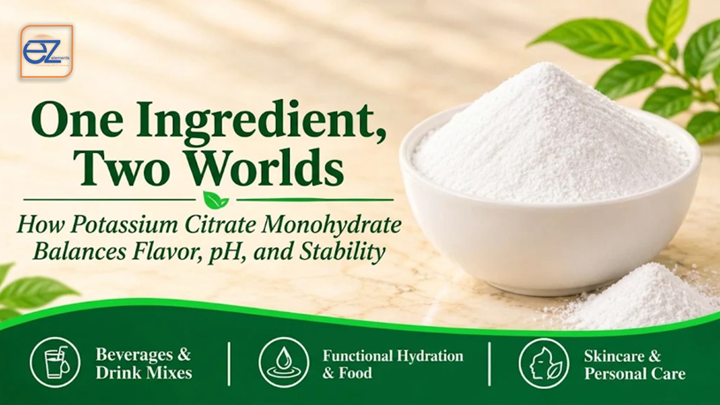
Ever taken a sip of a sports drink that bit back a little too sharply at the end, or applied a skincare serum that sparked an unexpected sting? Both are classic calling cards of a pH imbalance—the kind of quiet saboteur that keeps formulators awake long after the lab lights go out.
Enter Potassium Citrate Monohydrate (also known as Tripotassium Citrate Monohydrate, E332ii), a potassium salt of citric acid that steps in like a seasoned conductor. In one ultra-soluble white crystalline powder, it tunes pH, cushions harsh acidity, and delivers bioavailable potassium. Whether you are mixing up clean-label hydration or dialing in a high-potency facial serum, this versatile workhorse bridges the gap between sensory delight and rock-solid shelf stability.
The Balancing Act: Flavor, Hydration & Stability Across Two Industries
Great formulation rarely comes from brute force—it comes from balance. Too much sour bite, too much sting, too much sodium, or an emulsion that loses its nerve on the shelf can turn a promising concept into a costly rewrite. Potassium Citrate Monohydrate acts as the quiet peacekeeper that keeps every piece of the formula in harmony.
In the food and beverage kitchen, it plays the role of a master flavor architect. When carbonated sodas, juices, or low-calorie stevia blends come across too sharp or leave a lingering metallic shadow, this crystalline all-rounder smooths out harsh organic acids so the taste stays steady from the first sip to the last. Chasing serious hydration without the sodium baggage? Delivering ~36% bioavailable elemental potassium with no more than 0.3% sodium, it dissolves crystal-clear in cold water—fueling clean-label electrolyte mixes and coconut water blends with zero chalky fallout, while doubling as a silky emulsifying salt for smooth-melting processed dairy and firm, clean-setting pectin jellies.
Step across to the cosmetic bench, and that same poise transforms how actives behave on skin. Potent Alpha-Hydroxy Acids like glycolic and lactic acid earn their keep every day, yet unbuffered formulas can dip too low and leave sensitive skin stinging. Potassium Citrate Monohydrate holds serums, lotions, and haircare right in the sweet spot—calm enough for delicate skin, yet balanced enough to let active ingredients do their best work. Even better, it pulls double duty as a clean-label chelator, binding trace metals like iron and copper before they can spark rancidity or break delicate emulsions—giving formulators a smart, label-friendly way to protect shelf life while scaling back synthetic chelators like EDTA.
Frequently Asked Questions
Q1: What is the difference between Potassium Citrate Monohydrate and Tripotassium Citrate Monohydrate?
None at all—they are two names for the very same ingredient. Potassium Citrate Monohydrate is chemically identified as Tripotassium Citrate Monohydrate (CAS 6100-05-6, E332ii).
Q2:Why reach for Potassium Citrate Monohydrate instead of Potassium Chloride in electrolyte drinks?
Potassium chloride gets the job done on paper, but it is notorious for leaving behind a bitter, salty-metallic bite that is tough to disguise. Potassium Citrate Monohydrate brings a clean, mildly saline/cooling note while actively buffering beverage acidity.
Q3:Can Potassium Citrate Monohydrate help cut sodium in processed foods?
It can. With no more than 0.3% sodium, formulators often use it to replace sodium citrate or trim table salt in soups, sauces, processed meats, and savory snacks without giving up flavor balance or buffering power.
Q4: How easily does Potassium Citrate Monohydrate dissolve in cold processing?
Effortlessly. It offers high water solubility—dissolving at 1,670 g/L at 15°C and 1,997 g/L at 31°C—making it right at home in cold-fill beverages, liquid concentrates, and water-based skincare formulas.
Q5: What is the shelf life, and how should it be stored?
Typical batches hold a three-year shelf life under proper storage (always confirm exact dates on your batch-specific Certificate of Analysis). Because this powder is hygroscopic and loves to pull moisture from humid air, keep containers tightly sealed in a cool, dry space below 25°C to prevent caking.
Why EZ Elements Is Your Ingredient Partner
Finding a reliable raw ingredient is about more than chasing the lowest price per kilo—it is about keeping your production line moving and breezing through quality checks without hiccups. When you source Potassium Citrate Monohydrate (FCC/USP Grade) from EZ Elements, you get:
- Paperwork You Can Count On: Every batch comes backed by a verifiable Certificate of Analysis (CoA), Safety Data Sheet (SDS), and Technical Data Sheet (TDS).
- Room to Grow: Start small for benchtop stability tests, then step right up into bulk 25 kg moisture-barrier bags as demand picks up.
Ready to fine-tune your next formula? Reach out to the EZ Elements team to grab a Technical Data Sheet, request an R&D sample, or lock in a bulk quote—and tell us what you are building next.
Safe Handling, Storage & Regulatory Overview
Smart handling protects both your crew and the integrity of your raw materials. The guidance below reflects the safety data sheet for Tripotassium Citrate Monohydrate.
Handling & Protective Gear
Work inside enclosed systems with local exhaust ventilation whenever possible, and keep dust generation to a minimum. Suit up with safety glasses, protective gloves, and a particle mask or respirator where needed. Wash your hands thoroughly after handling, and keep food, drinks, and smoking strictly away from the work zone.
Heating & Fire Safety
If a fire breaks out, reach for water spray, dry powder, foam, or carbon dioxide. Responders should wear self-contained breathing apparatus and full protective gear. Keep the material well away from heat sources and humidity.
Storage & Spill Management
Keep bags tightly sealed in their original packaging inside a dry, ventilated, pollution-free space, shielded from direct sunlight. Store away from strong acids, strong bases, and strong oxidizing agents. If a spill happens, gather the material safely, keep it from entering the environment, and dispose of it at an approved waste facility.
Typical Shelf Life
An example batch carries a three-year shelf life when stored under the conditions above. Always check the Certificate of Analysis for your specific batch to confirm exact dates and specs.
Regulatory Status & Compliance
According to the safety data sheet, this material is not classified under transport regulations and is not classified as a hazardous substance under the referenced EC directives. Be sure to double-check the labeling rules that apply in your target market.
Technical Specifications
The table below lists product specifications from the technical data sheet.
| Property | Specification |
| Product name | Tripotassium Citrate Monohydrate (Potassium Citrate Monohydrate) |
| INCI name | Potassium Citrate |
| CAS number | 6100-05-6 |
| EC number | 232-433-8 |
| Appearance | White crystalline powder, different granular sizes |
| Odour | Almost odourless, slightly sour |
| Relative density (20°C) | 1.98 g/cm³ |
| Water solubility | 1670 g/L (15°C); 1997 g/L (31°C) |
| pH (50 g/L H₂O, 20°C) | 7.5 – 9.5 |
| Melting temperature | 180°C: loss of crystal water; above 230°C: melting |