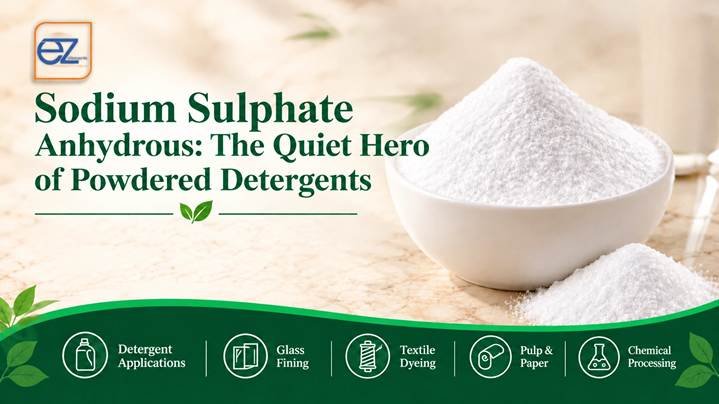
If you run a small cleaning brand or batch-crafting business, you know the ultimate heartbreak: a customer opens a fresh tub of your laundry powder or carpet freshener, only to find a solid, rock-hard brick instead of a smooth, scoopable powder.
That’s where Sodium Sulphate Anhydrous 99% steps in.
While active surfactants and essential oils usually grab the spotlight on the label, this high-purity inorganic salt is the behind-the-scenes workhorse that turns good formulations into retail-ready bestsellers.
Here is why this quiet hero deserves a permanent spot on your ingredient shelf:
The Clump-Fighting, Batch-Balancing, Dissolve-Everything Sidekick
Think of Sodium Sulphate Anhydrous 99% as the unsung hero of your batching station. Because it’s completely water-free, it locks up trace humidity before it can reach your actives: keeping powders light, free-flowing and scoopable from the first batch to the last. As a neutral, high-purity filler, it adds volume without diluting performance, so every scoop your customer opens carries the same balance of cleaners, scents and colours. And unlike chalky fillers that streak dark clothes or leave grit behind, it dissolves fast in hot and cold water with zero residue. Bonus: it works as a levelling agent too, dispersing dyes and fragrance oils evenly so there are no splotchy spots or scent pockets. Add it to your line and you’re not just padding a formula. You’re protecting it from humidity, extending shelf life, and giving your product that polished, professional finish.
And more than just in cleaning products: Sodium Sulphate Anhydrous across industries
Sodium Sulphate Anhydrous 99% may have made its name in custom detergent formulations, but this powder has range. Walk through a glass plant and you’ll find it playing bubble bouncer, coaxing trapped gas out of molten batches so pieces come out crystal-clear, with its low-iron pedigree making sure no unwanted green tint crashes the party. Over in the dye house, it’s the fairness referee, levelling colour across every fibre so batch forty matches batch one, rich and uniform every time. Pulp and paper mills count on its steady chemistry to keep the line humming without drama. And chemical manufacturers? They love it twice: once as a dry, dependable raw material, and again as a moisture-scavenging drying agent with a thirst that tops out at just 0.20% max moisture, keeping reactions locked on spec instead of drifting off-course.
Whether you’re weighing out small craft batches or running industrial-scale production lines, one rule travels with the powder: match your batch’s technical data and Certificate of Analysis (CoA) to your exact specifications, and it delivers consistent, high-quality results every single time.
Frequently Asked Questions
Q1: Is sodium sulphate anhydrous the same as sodium sulfate?
Yes — same powder, different spelling side of the border. Sodium sulphate anhydrous is anhydrous sodium sulfate (Na₂SO₄, CAS 7757-82-6). “Sulphate” is the Canadian and British way of writing it; “sulfate” is what our American friends type into their search bars. Whichever spelling you use, the chemistry doesn’t change: same molecule, same specs, same reliable performance.
Q2: What is sodium sulphate anhydrous used for in detergents?
Think of it as the supporting actor that makes the star look good. In powdered laundry and dishwashing detergents, it works as a filler and processing aid, adding bulk and keeping the powder free-flowing and scoopable. The product specification lists sodium sulphate content of at least 99.00%. When comparing grades, sodium sulphate filler or detergent filler chemical are good search starting points, then confirm suitability with your own formulation requirements.
Q3: Is sodium sulphate anhydrous hazardous?
Good news: this is one of the milder characters in the chemical cabinet. According to the supplied safety data sheet, it is not classified as hazardous under GHS and is not classified as dangerous goods for transport. That said, mild doesn’t mean careless. Avoid creating dust, handle with sensible workplace practice, and consult the current SDS for your batch and location.
Q4: How should it be stored?
Treat it like the moisture-hating professional it is. Keep it in a cool, dry, well-ventilated area in a tightly closed container, protected from humidity, and stored away from food and animal feed. Proper storage conditions matter at both the supplier’s facility and yours — this powder performs best when both ends of the supply chain hold up their side of the bargain.
Why EZ Elements Is Your Supply Partner
Sourcing a raw material is about more than price per kilogram. It also requires clear documentation, consistent quality, and responsive support. EZ Elements provides a TDS, SDS, and CoA for the product so your quality and EHS teams can review the relevant information.
Explore the EZ Elements industrial range or contact the team to request current documents, pricing, and information about available packaging.
Safe Handling, Storage & Regulatory Overview
Staying safe on the shop floor or in the lab is always top priority. Here is a practical breakdown of how to store, handle, and stay compliant with Sodium Sulphate Anhydrous 99%, based on its standard Safety Data Sheet (SDS).
Handling & Personal Protection
Always work in a well-ventilated area, using local exhaust ventilation if you’re mixing powders that might kick up dust. Team members and operators should wear standard protective gear: safety goggles, gloves, and protective work clothes. If your ventilation isn’t quite cutting it, pop on a dust mask or respirator—a PAPR or HEPA filter setup is ideal. And as always, give your hands a good wash after handling a batch.
Fire Safety & Emergency Response
- Hazard Class: Non-hazardous under GHS criteria per the SDS.
- Firefighting: Standard water spray, foam, or dry chemical extinguishers work fine. Just keep in mind that extreme heat can release toxic fumes, so responders should wear a self-contained breathing apparatus (SCBA) alongside full protective gear.
- Incompatibilities: Keep it away from strong acids and flammable materials. Store away from direct heat, moisture, and potential ignition sources.
First Aid Quick Reference:
- Eyes: Flush with water for at least 20 minutes and consult a doctor.
- Skin: Strip off contaminated clothing and rinse skin thoroughly.
- Ingestion: Rinse the mouth out with water—do not induce vomiting—and seek medical advice right away.
Storage & Spill Cleanup
- Storage Needs: Keep it in a cool, dry, well-ventilated space with containers tightly sealed. Protect it from ambient moisture and alkaline materials, and keep it clear of food or animal feed storage.
- Managing Spills: Keep dust down and ensure the area is ventilated. Sweep or absorb the spill using an inert material, transfer it to a covered disposal container, and make sure it stays out of storm drains and waterways.
- Shelf Life: Typical batches have a two-year shelf life when stored correctly in sealed containers. Always double-check the Certificate of Analysis (CoA) for your specific shipment to verify exact batch details.
Regulatory & Transport Status
- Chemical Inventories: The product is not flagged as hazardous under TSCA, DSL, EU, or OSHA guidelines, and it isn’t subject to EPCRA or CERCLA reporting requirements.
- Shipping: It is not classified as a dangerous good for transport, making standard freight straightforward.
Technical Specifications
The details below are pulled straight from standard Technical and Safety Data Sheets. Because minor batch variations can happen, always check the official Certificate of Analysis (CoA) and documentation shipped with your specific order to confirm your exact numbers.
| Property | Specification |
| Product Name | Sodium Sulphate Anhydrous 99% |
| Chemical Name | Anhydrous sodium sulphate |
| Chemical Formula | Na₂SO₄ |
| CAS Number | 7757-82-6 |
| EC Number | 231-820-9 |
| Molecular weight | 142.04 g/mol |
| Sodium sulphate content | ≥ 99.00% |
| Insoluble material | ≤ 0.05% |
| Calcium and magnesium (as Mg) | ≤ 0.15% |
| Iron content | ≤ 0.002% |
| Moisture | ≤ 0.20% |
| Whiteness | ≥ 82 |
| pH value | 7.0 – 10.0 |
| Chloride (Cl) content | ≤ 0.35% |
| Melting point | 884°C |
| Density | 2.671 g/cm³ |
| Solubility in water (20°C) | 161,000 – 190,000 mg/L |