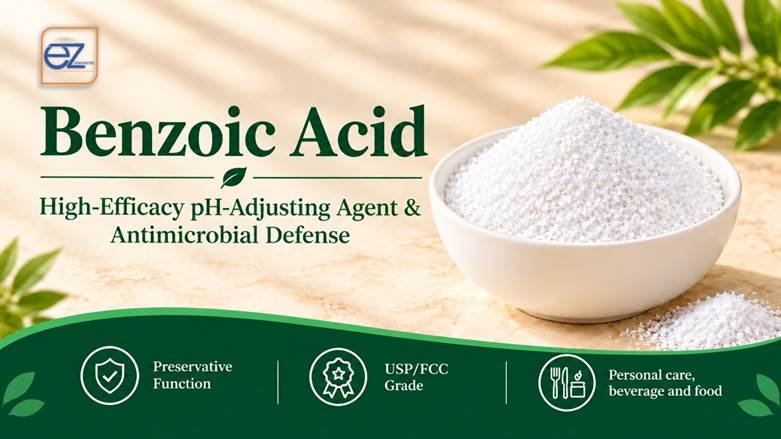
In the fast-moving world of cosmetics and food processing, keeping products fresh, stable, and mold-free isn’t just nice to have—it’s everything.
Enter Benzoic Acid 99% a high-purity, broad-spectrum antimicrobial powerhouse that works quietly behind the scenes to protect your formulas. Featuring a fine, white crystalline texture and a subtle, faint balsamic aroma, it delivers maximum preservation with virtually zero sensory impact on your finished products.
Whether you’re developing the next clean-beauty skincare line or crafting shelf-stable food and beverage formulations, Benzoic Acid is the trusted, globally accepted defender against mold, yeast, and fungal contamination.
Fun Fact: Benzoic Acid is Clean Beauty’s Favorite “Nature-Identical” Shield!
Did you know that Benzoic Acid was actually one of the very first preservatives discovered in nature? Long before lab coats and skincare routines were a thing, nature was already using it to protect plants. It naturally occurs in delicious berries like cranberries, blueberries, and lingonberries, as well as plums, apples, and even sweet vanilla beans!
Here is why it’s taking the cosmetic and personal care world by storm: Next time your favorite clean-beauty moisturizer stays fresh, silky, and mold-free on your bathroom shelf for months, you can thank the same protective chemistry that keeps wild cranberries fresh on the vine!
Did you know…? Benzoic Acid is the Winemaking’s Secret Fermentation Brake
When you think of fine wine, images of sun-drenched vineyards, oak barrels, and sommelier pour usually come to mind. But behind every perfectly balanced bottle of sweet wine or fruit wine lies a subtle chemical dance—and Benzoic Acid (often utilized alongside its soluble salt forms, like sodium benzoate) plays a fascinating, behind-the-scenes role.
In winemaking, timing is everything. Once a sweet or fruit wine reaches its ideal level of residual sugar, winemakers need a reliable way to tell the yeast, “Take a break!” Benzoic acid acts as an effective fermentation arrestor. By penetrating yeast cell membranes in low-pH wine environments, it stops active fermentation in its tracks, preventing bottle re-fermentation (which can turn smooth wine dangerously frizzy or blow out corks) and keeping sweet wines perfectly balanced, crystal clear, and shelf-stable from the cellar to your glass.
Frequently Asked Questions
Q1: How is Benzoic Acid 99% used as preservative?
It functions as a broad-spectrum antimicrobial preservative that inhibits the growth of mold, yeast, and fungal contamination in acidic formulations. It is widely used across cosmetic formulations, food processing, and chemical synthesis to extend product shelf life.
Q2: Why is Benzoic Acid 99% popular in clean-beauty cosmetic formulations?
Benzoic Acid 99% is highly valued in the clean-beauty industry as a paraben-free, formaldehyde-free preservative alternative. Naturally found in fruits like cranberries and apples, its natural-identical organic structure allows cosmetic chemists to design gentle, safe, and effective preservation systems that satisfy modern consumer demand for non-toxic personal care ingredients.
Q3: How does formulation pH affect Benzoic Acid in skincare products?
Benzoic acid requires an acidic environment to function as an active antimicrobial agent. It functions at a pH of 4.5 or lower (ideally between pH 3.0 and 4.2), where it remains in its undissociated, lipophilic state to neutralize mold, yeast, and fungi. Because human skin has a natural pH mantle around 4.5–5.5, Benzoic Acid works synergistically in skin-friendly formulations while also acting as a pH-adjusting agent.
Q4: In what types of personal care products is Benzoic Acid commonly used?
It is widely used across both leave-on and rinse-off personal care products, including:
- Skincare: Facial cleansers, anti-aging toners, moisturizers, serums, and eye creams.
- Haircare: Clarifying shampoos, hair conditioners, and scalp treatments.
- Body Care: Body washes, bath gels, and lotion emulsions.
Q4: Will Benzoic Acid 99% affect the fragrance or odor profile of cosmetics?
Benzoic Acid exhibits a faint, pleasant, balsamic aroma in raw form, but at standard cosmetic preservation levels (0.05% to 0.5%), it has a negligible sensory footprint. It will not alter, overpower, or mask delicate essential oils, fine fragrances, or unfragranced skincare bases.
Q5: What is the role of Benzoic Acid or Benzoate additives in winemaking and beverage fermentation?
In winemaking and fermented beverage processing, benzoic compounds are utilized as fermentation arrestors and stabilization agents. When added to finished or sweetened wines, they halt active yeast activity, preventing re-fermentation in the bottle and protecting sweet wines or wine coolers from cloudiness and wild yeast spoilage.
Q6: Why must canning and winemaking products maintain an acidic pH when using Benzoic Acid?
Benzoic acid requires a low-pH environment to activate its preservative properties. In both canning (pickles, fruit preserves) and winemaking (which naturally operates between), the low pH keeps Benzoic Acid in its un-ionized form. This allows the molecule
to𝑝𝐻 penetrate3. 0𝑎𝑛𝑑3. 8yeast and mold cell walls, halting cellular energy production and preventing spoilage.
Why Choose EZ Elements as Your Supplier
Need all the specs and safety details to keep your team happy? We’ve got you covered! You can snag our Technical Data Sheet and Safety Data Sheet anytime upon request, and every single batch comes with its very own fresh Certificate of Analysis so you know exactly what you’re getting. Plus, if you ever hit a brain-teaser or want to double-check if a specific grade is the absolute perfect match for your formula, just reach out to the EZ Elements team—we’re always excited to talk chemistry, help you crunch the numbers, and make sure your next big batch is a total success!
Safe Handling, Storage & Regulatory Overview
Because safety and handling protocols are vital for laboratory and factory environments, all guidelines below are aligned with the official MSDS for Benzoic Acid 99%.
Handling & Protective Gear
Always handle raw chemical materials in a well-ventilated work area to prevent dust buildup. Formulators and plant operators should wear safety glasses, protective gloves, and suitable clothing to avoid serious eye damage and skin irritation. If ventilation is insufficient, use suitable respiratory equipment to avoid breathing in dust, and be sure to wash hands thoroughly after handling bulk batches and keep the product away from food, drink, and animal feed.
Heating & Dust Safety Precautions
- Dust Control: Fine airborne particles can form explosive dust-air mixtures. Take precautions to prevent the formation of dust clouds and do not breathe in chemical dust.
- Controlled Heating: Keep away from heat, sparks, open flames, and any other ignition sources during storage, handling, and formulation processing.
- Emergency First Aid: For eye contact, rinse cautiously with water for several minutes, remove contact lenses if easy to do, and call a physician immediately. For skin contact, wash thoroughly with plenty of water and remove contaminated clothing. If swallowed, rinse your mouth and call a poison centre or doctor if you feel unwell.
Storage & Spill Management
- Storage Conditions: Store in a cool, dry, and well-ventilated place in a tightly sealed container, fully protected from direct sunlight. Keep shielded from moisture, metals, and incompatible materials including strong oxidizing agents, reducing agents, and bases.
- ● Spill Cleanup & Environment: Avoid release of raw material into the environment. Collect spillage carefully with a clean shovel into a dry container and cover without compressing the material, then clean the surrounding surface thoroughly.
- Typical Shelf Life: Has a two-year typical shelf life when stored in a cool, dry, and tightly sealed container away from direct sunlight, ambient humidity, and incompatible agents. Always review the Certificate of Analysis (CoA) provided with your specific EZ Elements order for exact batch expiration dates.
Regulatory Status & Compliance
- Global Inventory Listings: Listed on the US TSCA Inventory (active), Canadian DSL, European EINECS, Australian AICIS, Philippine PICCS, and Japanese ENCS inventories.
- Canada WHMIS & Global Classification: Rated Danger due to potential harmful effects if swallowed (H303), skin irritation (H315), serious eye damage (H318), lung damage through prolonged or repeated inhalation (H372), and aquatic toxicity (H402).
- Transport: Not classified or regulated as a hazardous material for transport.
Technical Specifications
The table below lists product specifications from the technical data sheet.
| Property | Specification |
| Product Name | Benzoic Acid USP39/FCC10 |
| CAS Number | 65-85-0 |
| EINECS Number | 200-618-2 |
| Formula | C₇H₆O₂ |
| Appearance (25°C) | White crystalline flakes or powder |
| Identification (infrared absorption) | Positive |
| Assay | 99.5 – 100.5% |
| Water | ≤ 0.7% |
| Residue on ignition | ≤ 0.05% |
| Lead | ≤ 2 ppm |
| Solidification point | 121 – 123°C |
| Readily carburisable substances | Passed |
| Readily oxidisable substances | Passed |
| Shelf life | Two years |