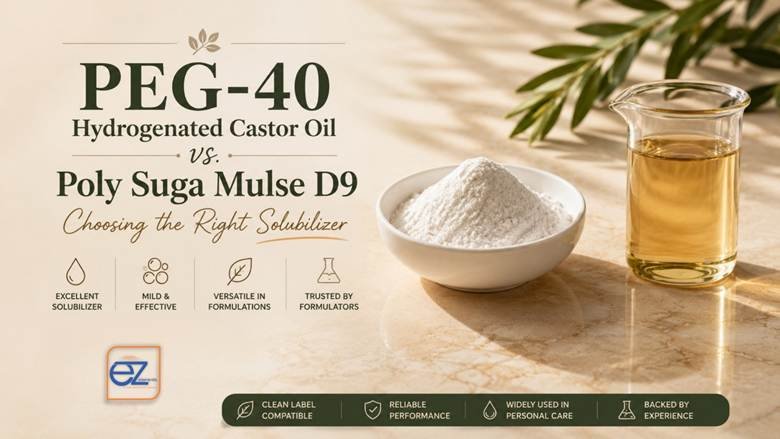
Both PEG-40 Hydrogenated Castor Oil and Poly Suga Mulse D9 do a similar job on paper. Each solubilizes oils and fragrance into water-based systems, and each shows up constantly in lotions, cleansers, and fragranced personal care products. But they are built very differently, and that difference matters the moment a label claim, a sourcing question, or a sensitive formulation is on the table.
This guide breaks down what each ingredient actually is, how they compare, and when to reach for one over the other.
What Is PEG-40 Hydrogenated Castor Oil?
PEG-40 Hydrogenated Castor Oil is a nonionic, ethoxylated ester made by reacting 40 moles of ethylene oxide with hydrogenated castor oil. Its INCI name is PEG-40 Hydrogenated Castor Oil, and it carries a high HLB, in the range of 13 to 15, making it an effective emulsifier, solubilizer, and foam booster in a single ingredient. It has decades of use behind it across the personal care industry and is evaluated by the CIR Expert Panel as safe for use at concentrations up to 100%.
Because it is produced through ethoxylation, it is not considered a naturally derived ingredient, and as with other ethoxylated materials, manufacturing controls are used to purify out 1,4-dioxane and ethylene oxide residues from the finished product.
What Is Poly Suga Mulse D9?
Poly Suga Mulse D9 is a naturally derived, sugar-based emulsifier and fragrance solubilizer with the INCI name Sorbitan Oleate Decylglucoside Crosspolymer. Produced from sugar, corn, and vegetable oil through a patent pending process, it carries an HLB of 12 to 14, placing it in a similar functional range to PEG-40 Hydrogenated Castor Oil, but without an ethylene oxide step. It is PEG free, EO free, and 1,4 Dioxane free, and holds ECOCERT approval and USDA BioPreferred certification.
Key Differences at a Glance
| Property | PEG-40 Hydrogenated Castor Oil | Poly Suga Mulse D9 |
| Origin | Ethoxylated ester of hydrogenated castor oil; not naturally derived | Naturally derived from sugar, corn, and vegetable oil |
| HLB Range | Approximately 13 to 15 | Approximately 12 to 14 |
| Function | Emulsifier, solubilizer, surfactant, foam booster | Emulsifier and fragrance solubilizer |
| Ethoxylation / EO Free | Ethoxylated; 1,4-dioxane purified out during manufacturing | PEG free, EO free, 1,4-Dioxane free |
| Track Record | Long standing, widely used industry standard | Newer to market, growing adoption in clean label formulations |
| Clean Label Positioning | Conventional, not natural | ECOCERT approved, USDA BioPreferred certified |
| Typical Use Level | 1% to 10% | Rinse off 2% to 8%; leave on 1% to 3% |
Which One Should You Choose?
- Choose PEG-40 Hydrogenated Castor Oil if you need a proven, multifunctional emulsifier and solubilizer with a long formulation track record, and a fully natural label claim is not the priority.
- Choose Poly Suga Mulse D9 if you are formulating a clean label, naturally positioned product and want to avoid PEG and ethylene oxide derived ingredients while still achieving comparable solubilizing performance.
- Both work well as fragrance and oil solubilizers in water-based sprays, mists, and cleansing formulations, so the deciding factor is usually label positioning rather than raw performance.
Why Choose EZ Elements for Your Emulsifier and Solubilizer Needs
Whichever direction your formulation calls for, EZ Elements supplies both ingredients with the documentation and consistency Canadian formulators need.
- Full documentation, including Technical Data Sheets, Certificates of Analysis, and Safety Data Sheets, for every emulsifier and solubilizer
- Consistent HLB and specification, batch to batch
- Bulk supply with transparent, competitive pricing
- Technical support to help you choose between conventional and naturally derived options
Frequently Asked Questions
Q1: Can I substitute Poly Suga Mulse D9 directly for PEG-40 Hydrogenated Castor Oil?
In many formulations, yes, given their similar HLB ranges and solubilizing function, but usage levels and finished texture can differ. Always run a small test batch when switching between the two.
Q2: Is PEG-40 Hydrogenated Castor Oil unsafe because it is ethoxylated?
No. The CIR Expert Panel has evaluated it as safe for use at concentrations up to 100% in cosmetic formulations. The ethoxylation process is a manufacturing consideration relevant to natural or clean label positioning, not a safety concern on its own.
Q3: Which ingredient is better for a fragrance spray?
Both perform well as fragrance solubilizers in water-based sprays. PEG-40 Hydrogenated Castor Oil has a longer track record in this application, while Poly Suga Mulse D9 is the better fit if the product is positioned as naturally derived.
Q4: Where can I buy PEG-40 Hydrogenated Castor Oil or Poly Suga Mulse D9 in bulk in Canada?
Both PEG-40 Hydrogenated Castor Oil and Poly Suga Mulse D9 are available for bulk purchase directly from EZ Elements, with supply options for personal care manufacturers and formulators across Canada.
Related Ingredients
The following EZ Elements ingredients are commonly used alongside PEG-40 Hydrogenated Castor Oil and Poly Suga Mulse D9 in personal care formulations:
- Polysorbate 20 A nonionic emulsifier and solubilizer with a comparably high HLB, often compared against both ingredients in this guide.
- Emulsifying Wax NF A self-emulsifying wax frequently used as a primary emulsifier alongside either solubilizer as a co-emulsifier.
Order or Enquire
Looking to buy PEG-40 Hydrogenated Castor Oil or Poly Suga Mulse D9 in bulk? Contact EZ Elements for current pricing, full product documentation, and supply options across personal care formulation. We supply brands, manufacturers, and formulators across Canada.