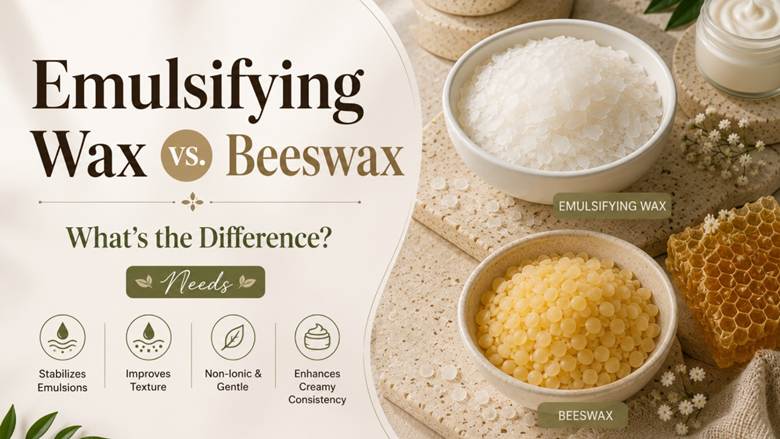
Both Emulsifying Wax NF and Beeswax show up constantly in cream, lotion, and balm recipes, and it is a fair question to ask whether they do the same job. They do not. While both are waxy, solid at room temperature, and used to build the texture of a finished product, they behave very differently once they hit a formulation, and understanding that difference can save a formulator from a batch that separates on the shelf.
This guide breaks down what each ingredient actually is, how they perform, and when to reach for one over the other, or use them together.
What Is Emulsifying Wax NF?
Emulsifying Wax NF is a non-ionic, self-emulsifying wax with the INCI name Cetearyl Alcohol (and) Polysorbate 60. It was purpose built for one job: binding oil and water into a stable emulsion. Because polysorbate 60 is included directly in the wax, it does not need a separate emulsifier or co-emulsifier to hold a cream or lotion together. Its melting point sits around 50°C to 54°C, and it is dispersible in both oil and water once melted.
Emulsifying Wax NF is not a fully natural ingredient, since polysorbate 60 is produced through an ethoxylation process, but it is one of the most dependable, widely used emulsifiers in conventional cosmetic formulation, valued for its consistency and ease of use.
What Is Beeswax?
Beeswax is a completely natural wax produced by honeybees, with the INCI name Cera Alba. Unlike Emulsifying Wax NF, beeswax was never designed as an emulsifier. It is a structural wax, prized in cosmetics for the firmness, plasticity, and protective film it lends to balms, lip products, and solid formulations. Its melting point runs higher, typically 62°C to 64°C, and it is insoluble in water.
Beeswax does have some traditional history as an emulsifier in water in oil systems, most famously in classic cold cream recipes, but on its own it does not reliably hold an oil and water formulation together the way a purpose-built emulsifier does. In most modern formulations, beeswax is used for structure, texture, and occlusive skin feel rather than as the primary emulsifier.
Key Differences at a Glance
| Property | Emulsifying Wax NF | Beeswax |
| INCI Name | Cetearyl Alcohol (and) Polysorbate 60 | Cera Alba |
| Origin | Partly synthetic; polysorbate 60 is ethoxylated | 100% natural, produced by honeybees |
| Primary Function | Self-emulsifying; binds oil and water | Structuring, thickening, and occlusive agent |
| Emulsifying Power | Reliable, purpose-built emulsifier on its own | Weak on its own; traditionally needs a co-emulsifier for a stable emulsion |
| Melting Point | 50°C to 54°C | 62°C to 64°C |
| Typical Use Level | 2% to 25%, commonly 3% to 10% | 1% to 20%, depending on the product type |
| Best Suited For | Lotions, creams, moisturizers, conditioners | Balms, lip products, solid lotions, salves |
| Clean Label Positioning | Conventional, widely used, but not natural | Natural, favored in clean beauty and natural formulations |
Which One Should You Choose?
The right choice comes down to what you are formulating and what your label needs to say.
- Choose Emulsifying Wax NF if you are building a lotion, cream, or conditioner that needs a stable, pourable or spreadable oil in water emulsion, and a fully natural label claim is not the priority.
- Choose Beeswax if you are building a lip product, or solid lotion where firmness, structure, and a natural label are the priority, and you are not relying on it to emulsify a high-water content formula.
- Choose beeswax paired with a dedicated emulsifier if you want a more natural formulation that still needs genuine oil and water stability, such as a natural cream or lotion.
Can You Use Emulsifying Wax NF and Beeswax Together?
Yes, and it is a common combination. Formulators often use Beeswax for body, structure, and a protective skin feel, while relying on Emulsifying Wax NF to do the actual work of holding the oil and water phases together. This lets a formulator get the natural, structural benefits of beeswax without gambling on its limited emulsifying power in a water rich formulation like a lotion or cream.
Why Choose EZ Elements for Your Formulation Ingredients
Whichever wax your formulation calls for, EZ Elements supplies both with the documentation and consistency Canadian formulators need.
- Full documentation, including Technical Data Sheets, Certificates of Analysis, and Safety Data Sheets, for every wax and emulsifier
- Consistent melting point and specification, batch to batch, for both Emulsifying Wax NF and Beeswax
- Bulk supply with transparent, competitive pricing across all available pack sizes
- Technical support to help you choose and combine the right waxes and emulsifiers for your formulation
Frequently Asked Questions
Q1: Can beeswax replace Emulsifying Wax NF in a lotion recipe?
Not reliably on its own. Beeswax was not designed as a primary emulsifier, and a lotion built only on beeswax is prone to separating over time. If you want a more natural formulation, beeswax is usually paired with a dedicated natural emulsifier rather than substituted directly.
Q2: Is Emulsifying Wax NF the same as beeswax?
No. They are chemically different ingredients with different functions. Emulsifying Wax NF is Cetearyl Alcohol and Polysorbate 60, purpose built to emulsify oil and water. Beeswax is Cera Alba, a natural structural wax primarily used for firmness and texture.
Q3: Which one is more natural, Emulsifying Wax NF or Beeswax?
Beeswax is a fully natural ingredient produced by honeybees. Emulsifying Wax NF is not considered natural, since it contains polysorbate 60, which is produced through an ethoxylation process.
Q4: Which wax should I use for a lip balm?
Beeswax is the more common choice for lip balms, since the goal is a firm, structured, protective product rather than a true oil and water emulsion.
Q5: Which wax should I use for a body lotion?
Emulsifying Wax NF is the more reliable choice for a body lotion, since it is a purpose-built emulsifier that will consistently hold an oil and water formulation together.
Q6: Where can I buy Emulsifying Wax NF and Beeswax in Canada?
Both Emulsifying Wax NF and Beeswax are available for bulk purchase directly from EZ Elements, with supply options for cosmetic brands, personal care manufacturers, and DIY formulators across Canada.
Related Ingredients
The following EZ Elements ingredients are commonly used alongside Emulsifying Wax NF and Beeswax in cream, lotion, and balm formulations:
- Emulsifying Wax NF A non-ionic, self-emulsifying wax for building stable oil in water creams and lotions.
- Beeswax Beads (White Cosmetic Grade) A natural, refined wax used for structure and firmness in balms, lip products, and solid cosmetics.
- Sweet Almond Carrier Oil A lightweight carrier oil frequently used in the oil phase of formulations built on either wax.
- Avocado Carrier Oil A rich, nutrient dense oil that pairs well with both waxes in intensive moisturizing formulations.
Order or Enquire
Looking to buy Emulsifying Wax NF or Beeswax in bulk? Contact EZ Elements for current pricing, full product documentation, and supply options across skincare, hair care, and balm formulation. We supply brands, manufacturers, and DIY formulators across Canada. Reach out today to request a sample, Technical Data Sheet, or a bulk pricing quote for your next project.